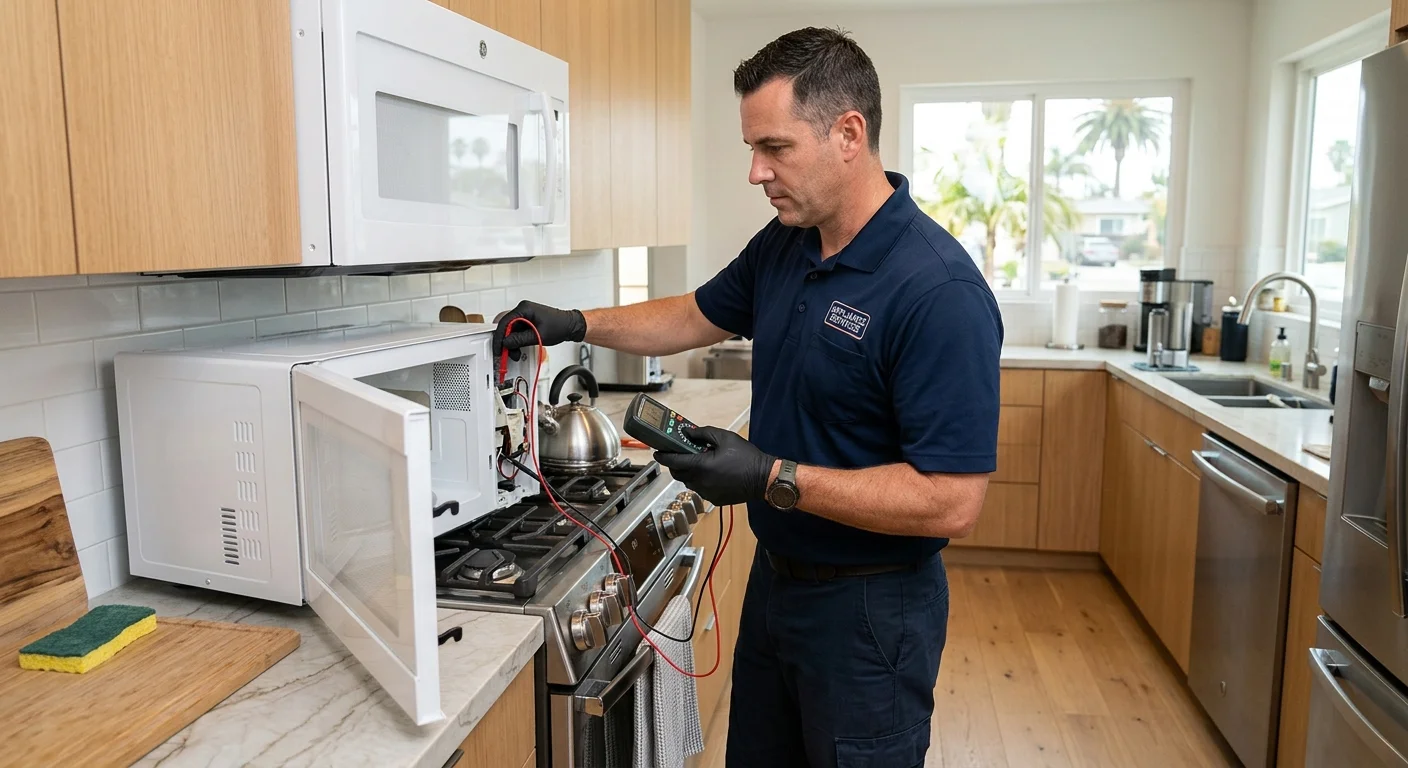
A microwave that hums but won’t heat is one of the most common calls we get. Whether you’ve got a countertop model or a built-in over-the-range unit, the failure usually traces back to a handful of parts. We’ll walk you through what actually breaks, what’s worth fixing, and why the inside of a microwave is the one appliance we tell people to leave alone.
Common microwave problems: not heating, turntable stuck, strange noises
Most microwave failures fall into a few buckets. Knowing which one you’re dealing with helps you describe it to us over the phone. It also tells you fast whether it’s a cheap fix or a unit that’s done.
The most common call is a microwave not heating even though everything looks normal. The light comes on, the plate spins, the timer counts down, but the food stays cold. That points to the high-voltage side. Usually it’s the magnetron, the part that actually produces the microwave energy. Sometimes it’s the high-voltage diode or capacitor feeding it. A technician tests these with a meter before condemning anything. A bad magnetron is also why some units start fine and then quit heating once they warm up.
Then there’s the turntable. If it won’t spin, food heats in cold and hot patches. The fix is usually one of three things. The turntable motor under the floor has failed, the plastic drive coupler is stripped, or there’s food debris jammed in the roller guide. A technician pulls the plate and the support ring first. Half the time it’s just gunk, and that’s a quick clean, not a part.
Noise is the next flag. A healthy microwave is fairly quiet. Loud buzzing often means the high-voltage transformer or a failing magnetron. Grinding or whirring usually traces to the stirrer motor or the cooling fan. On an over-the-range unit, a rattling or weak vent fan and a dead cooktop light are their own common failures, separate from the cooking side. Door problems show up too. The three interlock switches in the door latch tell the microwave it’s safe to fire. When one fails, the unit may run dead with no heat, or refuse to start at all.
Sparking inside the cavity is the one to take seriously. Stop using it and unplug it. It usually means the waveguide cover behind the right wall has burned through, or there’s arcing off the diode. Keep running it and you can take out the magnetron. That turns a small fix into a much bigger one.
Is it worth it to repair a microwave?
We give people the same honest math we’d use on our own kitchen. It comes down to the type of microwave, its age, and what part failed.
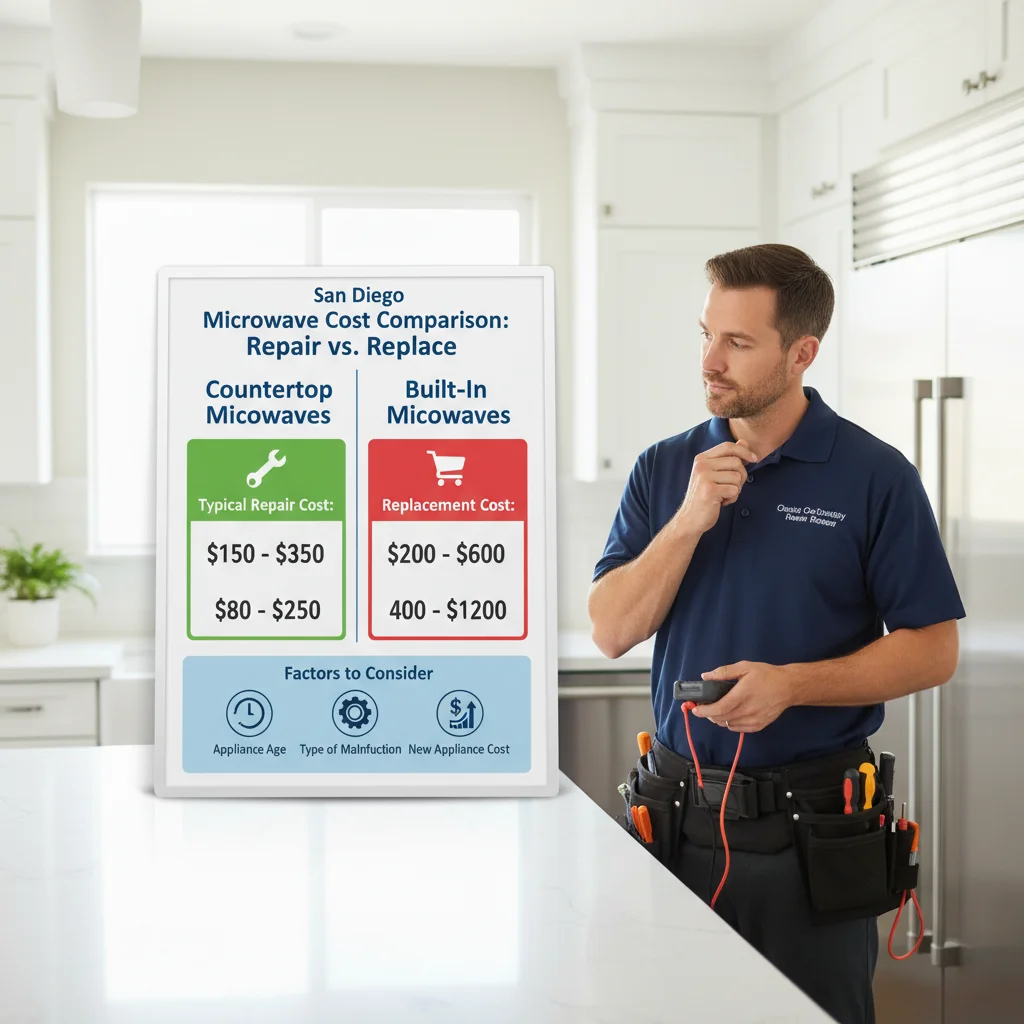
Countertop models are the easy call. A basic one is cheap to replace, and once it’s a few years old, paying for parts and labor on a dead magnetron rarely beats buying new. We’ll tell you that straight. The exception is a newer unit or a higher-end inverter model with a real warranty left on it. Those are worth fixing, and the repair often comes down to one part.
Built-ins flip the math the other way. Over-the-range, drawer, and trim-kit units cost a lot more up front, and the install isn’t a swap. The new unit has to match the opening, the trim, and on an OTR, the vent ductwork. Replacing one can mean cabinet work on top of the appliance cost. So when the failed part is something common like a magnetron, a door switch, a control board, or a turntable motor, fixing it almost always wins. We see plenty of built-ins where the whole microwave is fine and one cheap, small interlock switch took it down.
We don’t guess at this over the phone. A tech opens it up, finds the actual fault, and gives you a clear estimate before any work starts. Then you decide. No pressure either way.
Local techs repair all major brands, including GE, Whirlpool, and Samsung
Brands share more parts than people think. A magnetron, a diode, a door switch, and a turntable motor work the same way whether the badge says GE or Samsung. What changes is the layout inside and the control board, so the techs in our network carry the common parts and know where each maker hides them.
The network works on GE microwave units along with Whirlpool, Samsung, LG, Kenmore, Maytag, and Bosch. On Samsung and LG, technicians see more control board and membrane keypad faults, where buttons go dead or the panel locks up. On the older GE and Whirlpool OTR units it’s more often the magnetron or a worn door latch. If your microwave isn’t on that list, call anyway. The internals are the same family of parts.
Local techs service every type in San Diego homes. Countertop units are simple to get to but still pack the same high-voltage parts inside. Over-the-range units add a vent fan, a grease filter, and a cooktop light, so there’s more that can go wrong. Drawer and built-in trim-kit units take more time to pull and reseat, since they’re locked into the cabinetry. Whatever you’ve got, a tech can diagnose it on site. Learn more about our microwave repair services here in San Diego.
Safety first: why microwave repair is not a DIY job
We tell everyone the same thing. A microwave is the one kitchen appliance you don’t open. It holds a lethal charge even after you unplug it. That’s not a sales line. It’s the reason every technician in the network is trained to discharge the unit first.
The danger is the high-voltage capacitor. It stores a charge of up to 5,000 volts, and that’s enough to kill. Pulling the plug does not drain it. The charge can sit there for a long time after the power’s off. Before touching anything inside, a technician shorts the capacitor terminals with an insulated tool to bleed it down. Skip that step and a single slip puts that charge through your hand. There’s no safe way to do it without the right tool and the training to use it.
The magnetron is the other reason to keep the cover on. It’s the part that makes the actual cooking energy. A cracked or mishandled magnetron, or a microwave run with the cabinet open, can leak energy that’s harmful to you. A technician tests and seals these parts so the unit is safe to use again before handing it back.
There’s also the simple risk of turning a small fix into a dead unit. One wrong move on the board or the wiring and a cheap repair becomes a replacement. Leave the inside to a qualified tech. You can verify an appliance repair company’s registration through the California Bureau of Household Goods and Services website. Technicians in the network follow the same discharge-first routine on every single call.
Schedule your San Diego microwave repair
A failing microwave doesn’t always mean buying a new one. On a built-in especially, a single part can put it right. Homeowners across San Diego County get matched with a technician who starts every job with a real diagnosis, not a guess.
Technicians in the network are local. If the microwave is not heating or you smell burning, stop using it and say that in the voicemail. The matched technician sets timing after reviewing the request. They carry the common parts on the truck. Magnetrons, diodes, door switches, and turntable motors cover most of what they find, so a lot of repairs finish in one visit. You get the fault explained in plain terms and the estimate before work starts.
When it’s smarter to replace than repair, the technician will say so. The goal is your microwave working again, done safely, by someone who’s done the repair many times before.
Frequently asked questions
What brands do you repair in San Diego?
The technicians in our network service all major brands, including GE, Whirlpool, Samsung, LG, Kenmore, Maytag, and Bosch. Samsung and LG models tend to develop control board and membrane keypad faults, while older GE and Whirlpool over-the-range units more often fail from a worn magnetron or door latch.
Is a built-in microwave worth repairing?
Yes, in most cases. Over-the-range, drawer, and trim-kit units cost significantly more to buy and install than a basic countertop model, and replacing one can require cabinet work on top of the appliance cost. When the failure is a common part like a magnetron, door switch, or turntable motor, repair almost always wins over replacement.
Why does the microwave hum but not heat?
That combination points to the high-voltage side. A failing or dead magnetron is the most common cause. A burned-out diode is another. The diode converts AC power to the high-voltage DC the magnetron needs, and when it fails the magnetron gets no usable power. Both failures look identical from the outside.
Can I open my microwave to diagnose it myself?
No. The high-voltage capacitor stores up to 5,000 volts and holds that charge even after the unit is unplugged. Every technician in our network discharges the capacitor with an insulated tool before opening the cabinet. Skipping that step with a single slip puts a lethal charge through your hand.
When to call us
Sparking, smoke, a burning smell, or a unit that’s gone fully dead all mean stop and unplug it. Same goes for a microwave that hums but won’t heat. Those are the high-voltage failures we handle every week. Don’t open it up to chase them yourself. Call us at (858) 988-7787 to get matched with a local technician.