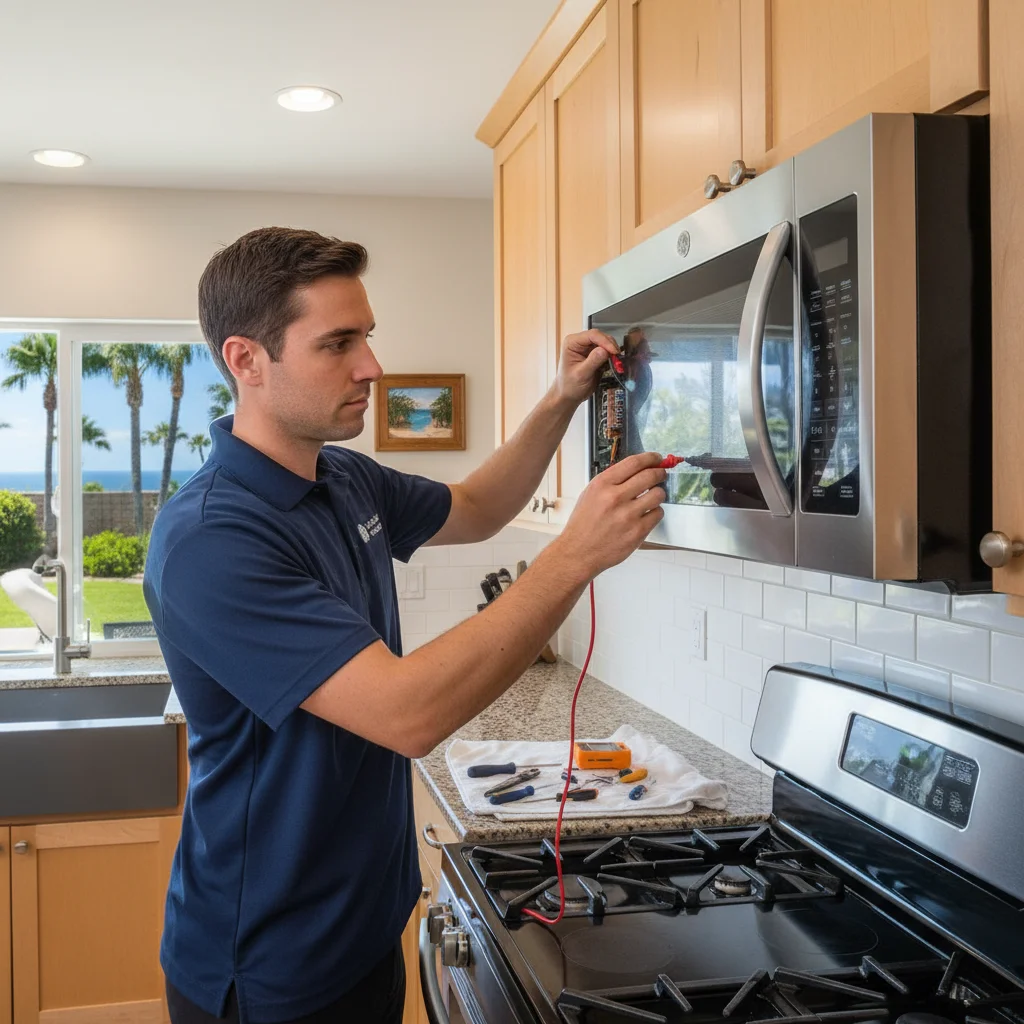
Your GE microwave runs every day until it doesn’t. The turntable stops spinning. The door won’t latch. Or it runs but your food comes out cold. The techs in our network can inspect all three at homes across San Diego County. Possible parts include the magnetron, door interlocks, and turntable motor. Those are model-specific. Here’s what a technician may sort out.
Common GE microwave problems in San Diego
A GE microwave that runs but will not heat is a frequent symptom. It is not ranked as the most common call. The turntable spins, the light comes on, the timer counts down, but the food stays cold. That can be a high-voltage part. The technicians in our network may test the magnetron, the high-voltage diode, and the capacitor. Order and outcome are model-specific. A failed diode can take the magnetron down with it. On older units a humming or loud buzzing right before the heat dies usually means the magnetron is on its way out. The technician confirms each part with a meter before replacing anything. No guessing.
Next up is the turntable that won’t turn. On most GE models the culprit is the small turntable motor under the floor of the cavity, not the tray itself. The technician pulls the unit out, drops the bottom panel, and checks the motor for continuity. Sometimes it’s just the plastic coupler or a roller guide that’s cracked, and food spillage cooked onto the support ring can bind it up too. A dead turntable means uneven heating and cold spots, so it’s worth fixing. Ask the matched provider whether they have the turntable motor for your model.
Door problems are their own category. Every GE microwave has three door interlock switches wired in series. They tell the unit the door is shut before it’ll fire. When a latch hook wears down or a hinge cracks, those switches stop closing in the right order and the microwave goes dead or throws an error. The techs in our network see a worn latch take out the line fuse and the monitor switch in one shot. The technician replaces the full latch assembly and tests all three switches, because a half-fixed door is a safety problem, not just an annoyance.
Then there’s the control panel. Buttons that don’t respond, a dark display, or a flashing error code usually point to the membrane switch (the flat keypad layer) or the main control board. The technician tests the membrane first since it’s the cheaper part and the more common failure. If the board is the issue, the technician checks the board’s connections and traces before condemning it, because a loose ribbon cable can fake a dead board. If you’re seeing sparking inside the cavity or burning smells, stop using it and call us. That’s a different and more urgent failure. If your GE microwave isn’t heating up your meals like it used to, our detailed guide on microwave not heating walks through more of what a technician checks.
Over-the-range vs. countertop models: what’s different
We see two GE microwave types in San Diego kitchens: over-the-range (OTR) and countertop. The internal heating parts are nearly identical. What changes is the access and the extra components. OTR units mount above the stove and double as your range hood. That saves counter space, but it adds a vent fan, fan motor, charcoal or grease filters, and ducting on top of the usual microwave guts.
OTR units take more work to service. To reach most parts, the technician has to unbolt the unit from the wall bracket and the cabinet above, then bring it down. That’s a two-person lift on the heavier GE Profile models. If you’re swapping an OTR unit rather than repairing it, wall-bracket and cabinet mounting is installation work beyond this referral. OTR units also have vent fans, fan motors, and cooktop lights that can fail. Grease in the duct can jam a fan blade. That is a possible inspection note, not a Kensington or La Mesa field statistic.
Countertop GE units are simpler. They plug into a standard outlet, so a technician can diagnose them on your kitchen table without dismounting anything. Same magnetron, diode, capacitor, and turntable parts inside, just easier to reach. No vent fan to fail, but no range hood function either. Either way, the core repair is the same set of parts. Ask the matched provider whether they have magnetrons, diodes, door latches, or turntable motors for your model. One-trip completion is their availability, not a Repair Pro promise.
When is a GE microwave worth repairing?
Repair or replace is a fair question. Typical microwave ranges are listed on how long do appliances last. They are typical, not a 7-to-10-year fact. A unit only a few years old is often worth fixing. The matched technician quotes in writing.
The part that broke matters just as much. A worn door latch, a dead turntable motor, or a blown line fuse can be straightforward once diagnosed. Outcome is not guaranteed. A burnt-out magnetron or a fried control board on a basic countertop unit is where replacement starts to make sense, because the part and labor can land close to the price of a new one. There is no 50% rule on this site. Compare the written quote to a comparable new GE.
OTR units shift that math. A built-in over-the-range GE costs a lot more than a countertop model and is bolted into your cabinetry, so repair tends to make more sense even when the failure is bigger. The technician also looks at the whole unit. If it’s clean and worked fine until this one part quit, fixing it buys you years. If it’s throwing different errors every few months, that’s a pattern, and a good technician will say so. The techs in our network give you the honest call on the spot. For more on this, read our guide on whether to repair or replace an appliance.
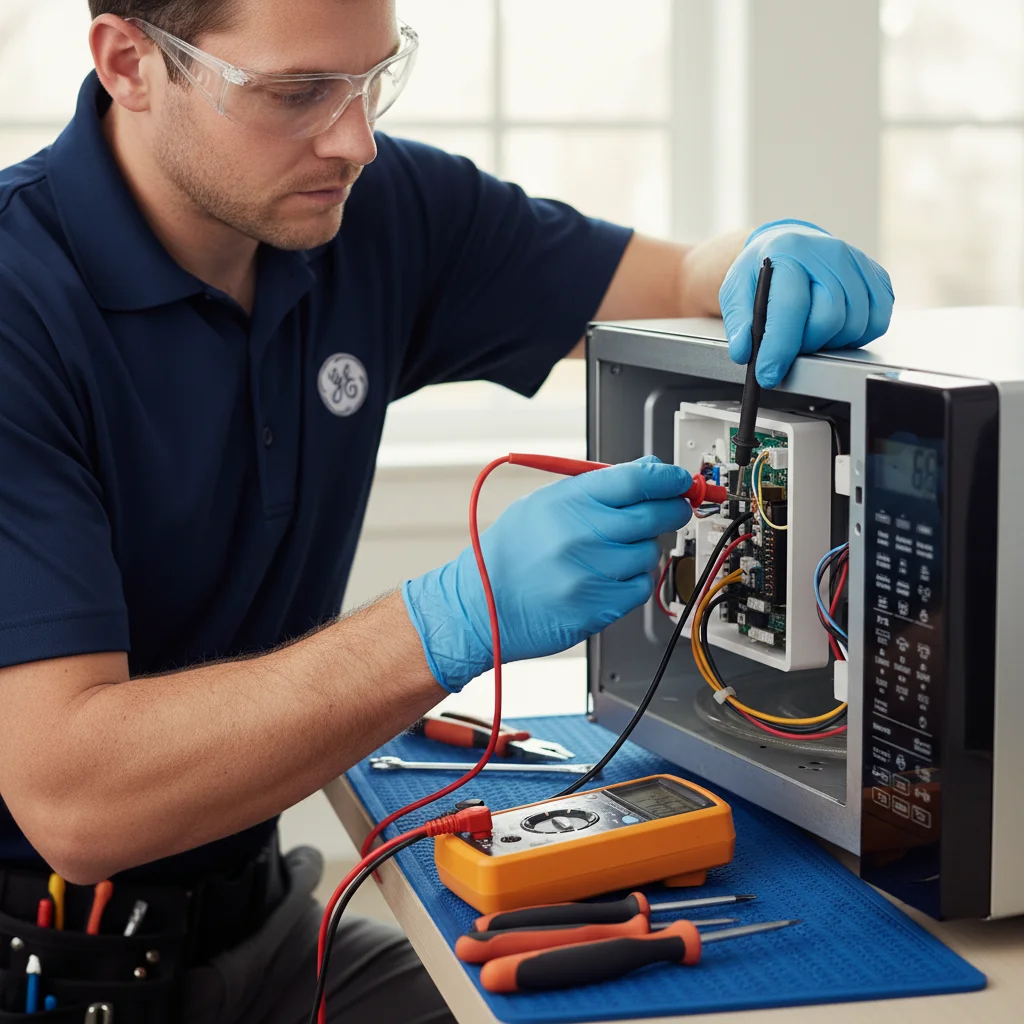
Safety first: why microwave repair is for pros
We’ll be straight with you. A microwave is the one kitchen appliance we tell people not to open. Inside sits a high-voltage capacitor that stores a charge long after you unplug the unit. We’re talking several thousand volts, and that charge can sit there for days. It doesn’t need to be running to hurt you. A shock from a charged microwave capacitor can stop your heart. This is not the same risk as changing a fridge gasket or a dishwasher hose. It’s the real reason we don’t recommend opening one yourself.
The first thing a technician does after opening a microwave is discharge that capacitor. The technician bridges its terminals with an insulated screwdriver or a discharge resistor before a hand goes near the high-voltage circuit. Skip that step and the capacitor bites. Past the capacitor, the magnetron, diode, and transformer all carry high voltage, and a wire grounded to the wrong spot can start a fire or leave the chassis live. The technician tests each part with a high-voltage probe, not by touch and hope.
Here’s the honest line. We’ve seen homeowners fix dryers and dishwashers fine, and we cheer that on. The microwave is the one we ask you to leave alone. Open it without discharging the capacitor first and a minor part swap turns into an ER trip. If you do hire someone, check that they’re registered and insured. You can check a California appliance repair company’s BHGS registration through the California Department of Consumer Affairs lookup. That lookup confirms registration status, not an individual technician’s skill.
Get a quote for your GE microwave repair
Here’s how a GE microwave request goes. Leave a voicemail with the symptom: cold food, dead display, door won’t latch, or a stuck turntable. We cover San Diego County and match you with a technician. The provider decides what to bring.
At your house, the technician runs the actual diagnostic. For a no-heat call that means metering the magnetron, diode, and capacitor after discharging it. For a dead unit it means checking the line fuse and the three door interlock switches. The technician finds the real cause instead of swapping parts and hoping. Then you get a clear quote before any work starts, and the technician fixes it once you approve.
Whether your GE isn’t heating, the door won’t latch, or the turntable’s stuck, leave a voicemail and we’ll get you matched with a technician. Learn more about our microwave repair services. The independent technician diagnoses first and quotes in writing.
Frequently asked questions
Why does my GE microwave run but not heat?
A microwave that times down, lights up, and spins the turntable but leaves food cold can have a high-voltage part failure. The technicians in our network can test the magnetron, high-voltage diode, and capacitor. A failed diode can take the magnetron down with it.
Is it worth repairing a GE microwave or should I just replace it?
Age and the failed part both matter. There is no 50% rule. A worn door latch, a dead turntable motor, or a blown line fuse is often worth doing. When the magnetron or control board fails on a basic countertop unit, compare the written quote to a new model. Over-the-range units often shift the math toward repair because they’re bolted into cabinetry.
Why is my GE microwave completely dead after the door stopped latching properly?
Every GE microwave has three door interlock switches wired in series. When a latch hook wears down or a hinge cracks, those switches stop closing in the right sequence and the microwave goes dead or throws an error. A worn latch can also blow the line fuse and the monitor switch in a single failure. The full latch assembly and all three switches need to be replaced and tested together, because a partially fixed door is a safety issue.
Can I repair a GE microwave myself?
The microwave is the one kitchen appliance we strongly recommend leaving to professionals. The high-voltage capacitor inside stores several thousand volts and holds that charge for days after unplugging. A shock from a charged capacitor can stop your heart. The magnetron, diode, and transformer all carry high voltage as well. The technicians in our network discharge the capacitor first with an insulated discharge tool before touching anything else inside.
When to call us
Some symptoms can wait a day. Some can’t. Sparking inside the cavity, a burning smell, or a door that won’t seal means stop using it and unplug it now. A buzzing magnetron or a stuck turntable can wait until a technician gets there. Either way, the high-voltage side calls for a professional, not a weekend project. Call us at (858) 988-7787 to get matched with a technician.