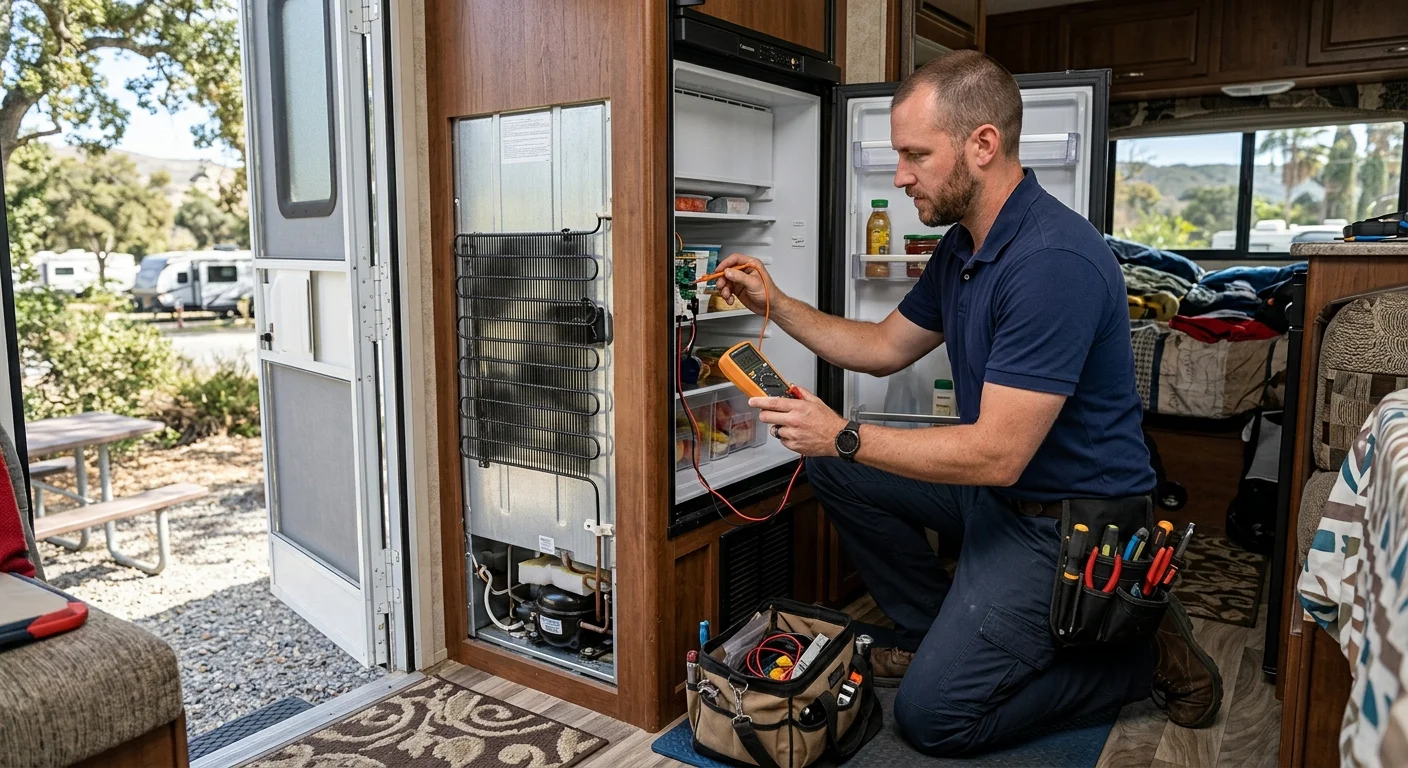
An RV refrigerator that stops cooling needs the right kind of service. Before requesting RV refrigerator repair, identify the model, supported power sources, and exact symptoms. Those details help you avoid booking a technician who doesn’t service your unit.
Start with the refrigerator model and power source
Find the refrigerator’s model and serial label first. Photograph the full label instead of copying it by hand. One wrong character can point a technician toward the wrong manual or parts diagram.
Next, check the owner’s manual for the supported power sources. Your control panel may also identify them. Record every option shown, such as shore power, battery power, or propane. Don’t assume an RV refrigerator supports a mode just because another unit does.
Some RVs contain purpose-built RV refrigerators. Others have residential-style refrigerators installed inside the vehicle. That difference matters when you request service. A technician who handles household refrigerators may not work on RV installations. Another pro may service certain RV models but not propane equipment.
Send these details before booking:
- Refrigerator manufacturer and complete model number
- RV manufacturer, model, and year
- Every power source listed in the manual
- Current control settings and displayed error codes
- Whether the refrigerator is built in or freestanding
- The RV’s location and available working space
Mention whether the unit is at a home, storage facility, or campground. Access conditions can change what a technician can inspect on site. If the refrigerator is near Escondido, our Escondido appliance repair guide explains what to share when seeking local service.
Repair Pro San Diego is a referral service. We match RV owners with licensed, insured independent technicians. Not every technician in the network handles every RV refrigerator type, so model and power-source qualification must happen before booking.
Cooling problems on electric and propane modes
Start with observations, not a guessed diagnosis. Follow the manufacturer’s instructions for selecting each supported operating mode. Don’t test a mode that isn’t listed for your refrigerator.
Write down what happens on each available mode. Does the control panel turn on? Does it show an error? Does cooling change only under one power source? Note when each test began and when you checked the compartment again.
A mode-specific pattern is useful, but it doesn’t prove which part failed. The control system, power supply, installation, or another component may still require testing. Share the pattern with the technician rather than ordering a part from an online diagnosis.
If propane operation is involved, say so before the appointment. Ask whether the technician services propane RV refrigerators and your exact model. Our separate guide to propane refrigerator repair in San Diego covers that narrower service question.
Protect the food while you document the problem. The FDA says a refrigerator should remain at or below 40°F. A freezer should stay at or below 0°F. Discard perishables after two hours above 40°F, or after one hour when the surrounding temperature exceeds 90°F. Food may be refrozen when a thermometer still reads 40°F or below.
San Diego County conditions can vary sharply between the coast and inland areas. Record the RV’s location and the temperature around it. Don’t use that information to diagnose the refrigerator. It gives the technician context for what you observed.
For a broader set of cooling checks, read the refrigerator not cooling checklist. Keep the RV model’s manual in control whenever its instructions differ.
What owners can document before requesting service
Good notes help a technician decide whether the job fits their experience. They can also reduce repeated troubleshooting questions. Keep the record factual and short.
Begin with photos of the data label, control panel, and current display. Include any error code exactly as shown. Don’t translate it into a diagnosis. Different models can use similar displays for different conditions.
Build a simple timeline. Record when cooling first changed and which operating mode was active. Note any recent storage, travel, power interruption, or installation work. If the manual contains setup or leveling instructions, record whether the RV met them when the symptom appeared.
If you already have a compartment thermometer, save the readings and their times. Don’t rely on how cold a shelf feels. A temperature record gives the technician clearer information and helps you apply the FDA food-storage limits.
You can also document:
- Whether both refrigerator and freezer sections are affected
- Whether the problem is constant or intermittent
- Which lights, displays, or alarms appear
- Any reset steps taken from the manufacturer’s manual
- The model-specific troubleshooting pages you followed
- Whether the same symptom returns after an approved reset
Check the manufacturer’s support page for current manuals and notices. Search the model through the CPSC recall database as well. A recall search isn’t a diagnosis, and similar model names aren’t enough. Confirm the complete model and serial information against the notice.
Documentation shouldn’t turn into disassembly. Refrigerant work has specific federal requirements. Technicians who attach gauges, add or remove refrigerant, or otherwise compromise the appliance’s sealed integrity must hold the appropriate EPA Section 608 certification. Ask about that credential when sealed-system work may be involved.
Which RV refrigerator faults need a technician
Request professional diagnosis when the refrigerator still won’t cool after the manufacturer’s listed checks. The same applies when an error returns after an approved reset. Persistent mode-specific failures also need testing beyond basic observation.
A technician should evaluate problems involving internal electrical testing, controls, sealed refrigeration components, or propane-related operation. Don’t assume one service provider covers all four areas. Describe the symptom and ask about each relevant capability before confirming the visit.
For 12 volt fridge repair, provide the exact voltage description printed on the unit or in its manual. “Battery refrigerator” isn’t specific enough. Ask whether the pro diagnoses that model and its installed power system. A household refrigerator specialist may decline RV electrical work, while an RV-focused provider may limit the refrigerator brands serviced.
Sealed-system work requires an EPA-certified technician. Section 608 certification applies when service involves attaching or removing hoses and gauges, adding or removing refrigerant, or compromising the appliance’s integrity. The certification doesn’t expire, but the relevant certification type still matters.
Warranty status should be checked before authorizing independent work. Read the warranty documents and contact the manufacturer with the model and serial number. Ask whether the manufacturer requires an authorized service facility or prior approval. Don’t rely on a seller’s informal summary.
California’s Song-Beverly Consumer Warranty Act provides protections for consumer goods sold at retail. When a manufacturer gives an express warranty, covered repairs generally must begin within a reasonable time and finish within 30 days. The law allows an exception for delays caused by circumstances beyond the manufacturer’s control. Actual coverage depends on the purchase, warranty, and facts, so confirm the process with the responsible manufacturer.
For conventional refrigerator issues, see our refrigerator and freezer repair service. Tell us that the appliance is installed in an RV so we can look for a suitable service match.
How to confirm service coverage in San Diego County
San Diego County is too large for vague location details. A provider serving central San Diego may not travel to coastal North County, inland North County, East County, or the South Bay. Give the full service location before booking.
Name the city and describe where the RV is parked. Service access near Oceanside or Escondido may differ from access in El Cajon, Chula Vista, or San Ysidro. Include campground or storage-facility rules that affect entry. Mention tight parking, gates, stairs, or limited exterior access.
Ask these questions before confirming a technician:
- Do you service this exact refrigerator manufacturer and model?
- Do you work on its listed power sources?
- Do you handle refrigerators installed inside RVs?
- Is the inspection mobile, shop-based, or either?
- Can you assess 12 volt operation if this model uses it?
- Do you service propane operation if this model supports it?
- Do you hold the appropriate EPA certification for refrigerant work?
- What information or access do you need before arrival?
California appliance repair businesses must register with the Bureau of Household Goods and Services. You can check a business through the state’s Department of Consumer Affairs lookup. That registration is separate from EPA certification and doesn’t demonstrate technical competency by examination.
Ask the technician about their diagnostic fee and whether it is credited toward the repair. Request the warranty terms for that technician’s work in writing. Repair Pro San Diego doesn’t set either policy and doesn’t perform the repair. The matched technician diagnoses first and quotes in writing before work begins.
When to call us
Call when your RV fridge isn’t cooling after the manufacturer’s checks, or when the fault involves internal components, refrigerant, propane operation, or 12 volt diagnosis. Confirm the model and power source so we can seek a licensed Appliance Repair pro with the right service capability. Call us at (858) 988-7787 to leave a voicemail with the model, power source, and service location. We’ll use those details to look for a licensed local tech who services that unit.