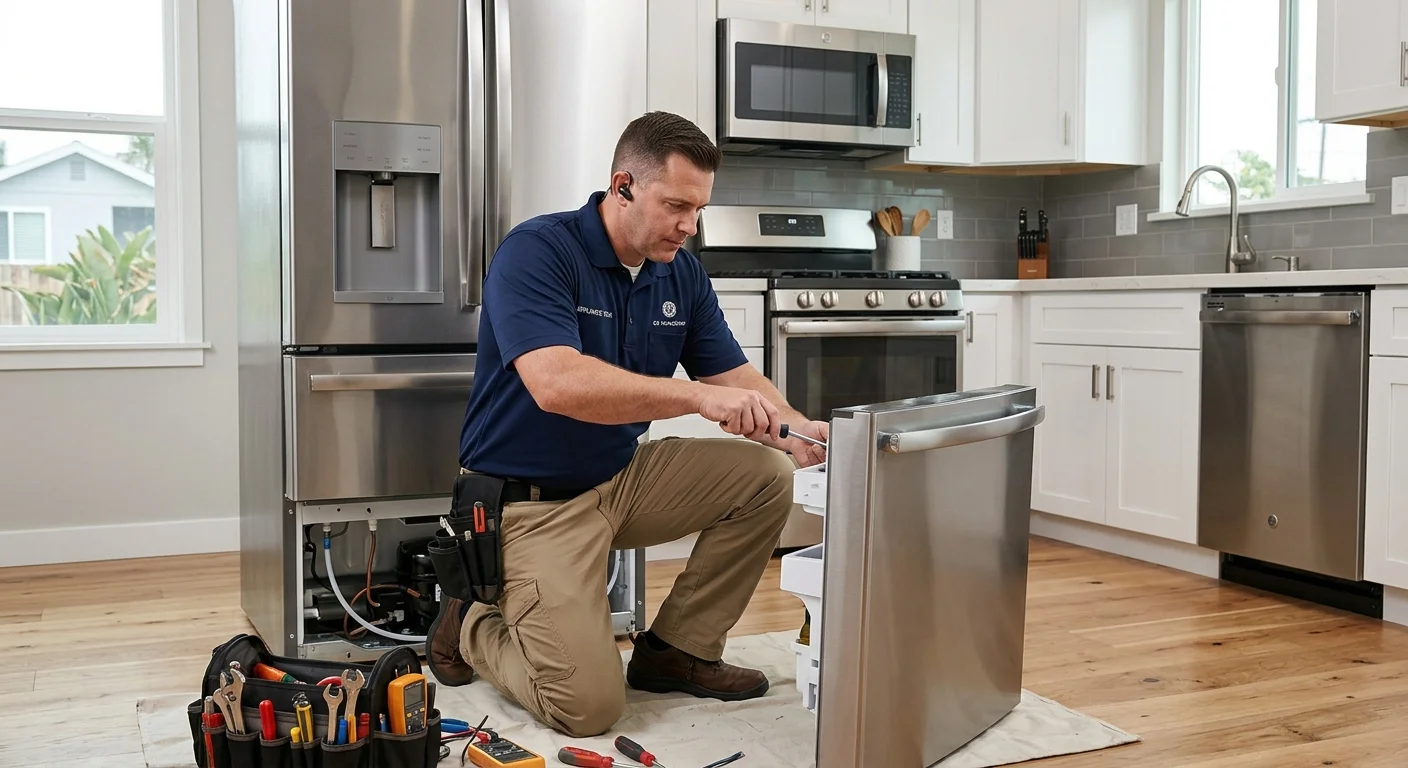
A dead GE appliance is more than an annoyance. A warm fridge spoils a week of groceries, a stalled washer stacks up laundry, and a cold oven kills dinner. You want it fixed right by someone who knows how GE actually fails. The technicians in our network do. They work on GE refrigerators, washers, dryers, ovens, and microwaves across San Diego every week.
Your trusted network for GE appliance repairs in San Diego
GE appliances show up in a lot of San Diego kitchens and laundry rooms. Failure timing is not a 7-to-10-year rule. Technicians in our network work on GE from base-model fridges to Profile and Cafe. Possible inspection areas include electronic control boards, defrost components, ice maker assemblies, and washer and dryer control modules. The matched technician confirms the actual fault.
The Profile and Cafe series lean heavily on electronics. They run main control boards, display boards, and user-interface boards that can drop out from a power surge or a swollen capacitor. The technicians in our network can check stored fault codes, then test outputs before condemning a board. A failed sensor or a loose connector can mimic a dead board. Parts on the truck and first-visit completion are the independent provider’s availability, not a Repair Pro promise. Coastal homes can see corrosion on connectors. That is possible wear, not a salt-air rule.
GE refrigerator repair (including Profile and Cafe series)
A broken refrigerator is often an urgent matter, especially in San Diego’s warm climate. Technicians in our network specialize in GE refrigerator repair San Diego, addressing common issues with precision: temperature regulation problems, strange noises, water leaks, and ice maker malfunctions. They’re also highly familiar with GE’s premium lines, like the Profile and Cafe series. These models often feature advanced electronics and specialized components that require a technician with specific brand knowledge.
When a GE Profile fridge stops cooling, the compressor is only one possible cause. The defrost heater, defrost thermostat, or the control board’s defrost timing can fail, frost can pack the evaporator coil, and airflow to the fresh-food side can choke off. The freezer may still feel cold while the fridge warms. The technician confirms the actual part. On Cafe models, water on the floor can be a frozen defrost drain tube or a failing water inlet valve. Ice maker trouble can involve the fill valve, the icemaker module, or the optics board. Get the full picture on our refrigerator repair page. Ask the provider whether they have the part and whether they quote in writing before work begins.
Common GE washer and dryer issues
GE washers fail in a few familiar ways: won’t drain, won’t spin, or shakes the whole laundry room. A washer that will not drain may have debris in the pump, a failed pump, or a restricted hose. Confirm the cause on the model, not a usual ranking. On top-load models the lid switch is a frequent culprit. The machine won’t spin if it can’t confirm the lid is shut. Front-load GE washers that walk across the floor often have worn shock absorbers or a failing spider arm behind the drum. Technicians in our network also see a lot of control faults on GE’s electronic top-loaders, where the main board misreads the water-level pressure sensor and the cycle stalls. East County homes can have hard water, so technicians may check for scale on heating elements and valve screens. That is a possible factor, not a timed local cause. For a deeper rundown, see our post on common GE washer problems.
GE dryers come down to three big ones: no heat, loud squealing, or no tumble. No heat on an electric dryer points to a blown heating element, a tripped thermal fuse, or a failed high-limit thermostat. On gas models it’s usually the igniter or the gas valve coils. A loud squeal can mean the idler pulley or the rear drum bearing. No tumble can involve a drive belt, motor, or door switch. Frequency is not ranked here. Lint buildup in the vent run drives a lot of these failures, especially in older condos where the duct runs long. The technician clears the vent, replaces the worn part, and confirms the dryer hits proper temperature before leaving.
GE oven, stove, and microwave repair service
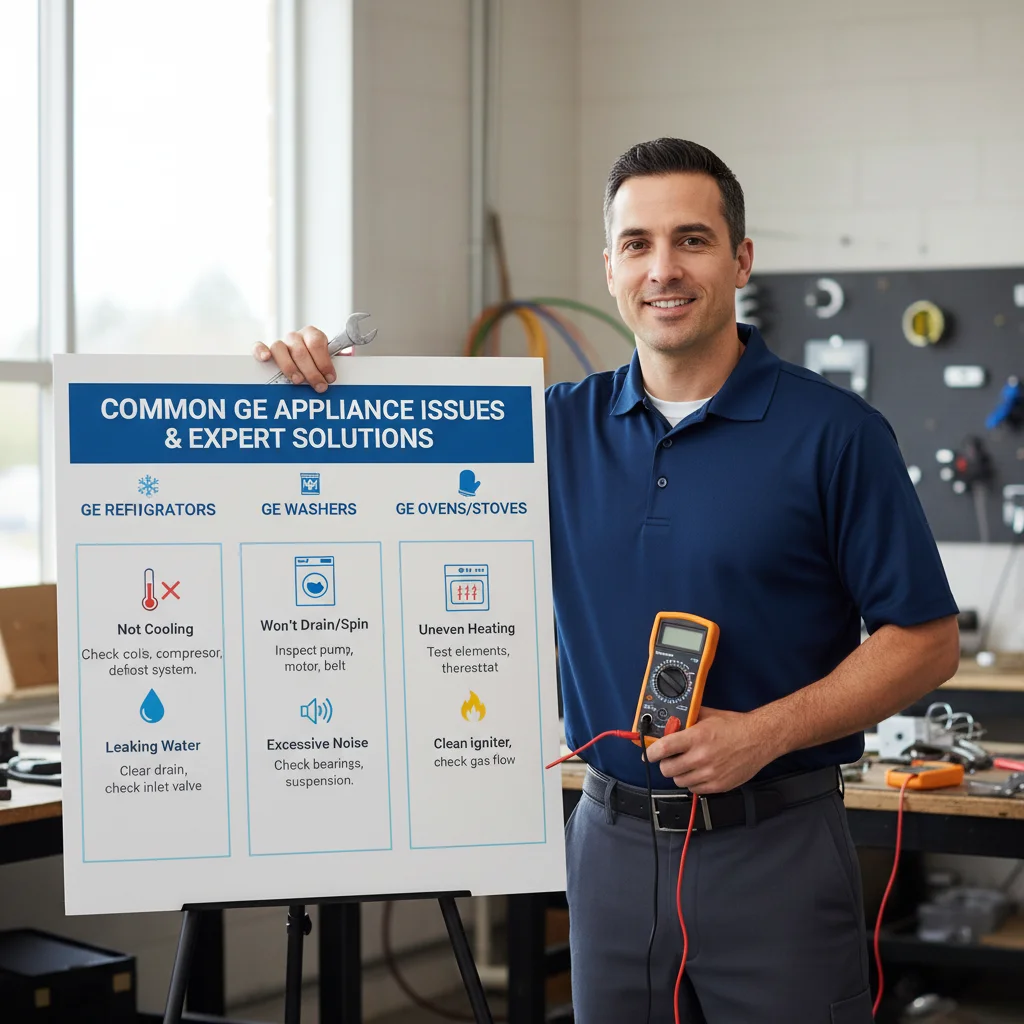
Cooking appliances are at the heart of every home, and a malfunctioning GE oven, stove, or microwave can bring meal preparation to a halt. Technicians in our network provide GE oven, stove, and microwave repair San Diego service. Whether your oven isn’t heating evenly, your stove burner won’t ignite, or your microwave has stopped working, there’s a technician with the expertise to diagnose and fix the issue.
If you see, hear, or smell signs of a gas leak, leave immediately and call 911 or SDG&E at 1-800-411-7343 from a safe location before any gas-appliance service request. This follows SDG&E’s gas-appliance safety guidance.
On GE gas ranges, a burner that clicks but won’t light can be a dirty or cracked igniter, or carbon in the burner ports. An oven that won’t reach temperature can involve the bake igniter or the gas valve. Those are technician checks. On electric ovens, uneven baking can trace to a bake or broil element or an oven sensor. GE microwaves that hum but won’t heat can involve a magnetron, a high-voltage diode, or a door interlock. Capacitors hold a charge. Do not open the microwave. Technicians in our network work on gas and electric GE cooking appliances. Outcome and stock are the provider’s.
Why choose us for your GE appliance service
Repair Pro San Diego matches you with independent technicians who can read GE fault codes and test parts before replacing them. We cover San Diego County, from coastal Encinitas and Carlsbad to inland Poway, El Cajon, and Chula Vista. The technician gives you a written quote before the work starts. The brand does not stock parts or complete visits.
Frequently asked questions
Why is my GE refrigerator fridge section warm when the freezer is still cold?
That pattern can point to a failed defrost system rather than the compressor. Frost can pack the evaporator coil and block airflow to the fresh-food side. The technicians in our network can check the defrost heater, defrost thermostat, and control board timing before condemning an expensive part.
What causes a GE washer to stop mid-cycle or throw a control fault?
Electronic top-loaders commonly stall when the main board misreads the water-level pressure sensor and the cycle can’t advance. On top-load models, a failed lid switch is also a frequent cause, since the machine won’t spin if it can’t confirm the lid is shut. Hard water scale on inlet valve screens can be a factor in East County homes. Ask the technician to inspect rather than treating it as the usual cause.
How do I know if my GE dryer needs a new heating element or just a cleaned vent?
If the dryer tumbles but produces no heat, a lint-clogged vent is always checked first since it drives a lot of no-heat failures, especially in older condos with long duct runs. If the vent is clear, the next checks are the heating element, thermal fuse, and high-limit thermostat on electric models, or the igniter and gas valve coils on gas models.
Do GE Profile and Cafe appliances cost more to repair?
Not necessarily more expensive to repair, but they require more careful diagnosis. These lines rely heavily on electronic control boards, and a failing sensor or loose connector often mimics a dead board. The technicians in our network read stored fault codes and test voltage outputs before replacing any board, which avoids unnecessary part costs on these higher-end models.
When to call us
When your GE washer, refrigerator, oven, or microwave shows signs of trouble, leave a voicemail at (858) 988-7787 to request a match. For a suspected gas leak, leave first and call 911 or SDG&E at 1-800-411-7343.