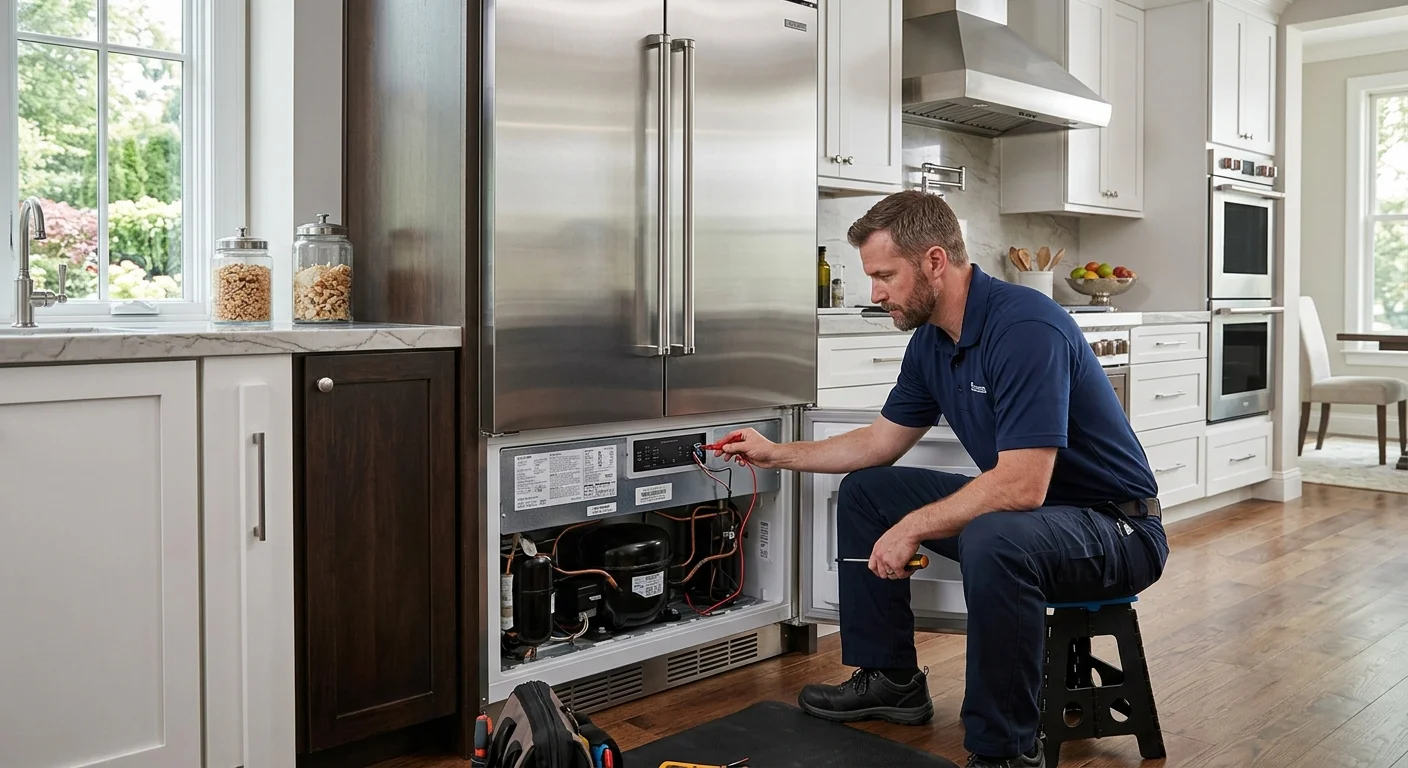
A Sub-Zero doesn’t work like the fridge from a big-box store. It runs two separate sealed systems, one for the fresh-food side and one for the freezer. When one fails, you need a tech who knows that design. The techs we match handle Sub-Zero refrigerators across San Diego County, including the built-ins in La Jolla, Rancho Santa Fe, Del Mar, and Fairbanks Ranch.
Why Sub-Zero refrigerators require specialized service
Most refrigerators run one compressor and one sealed system. A Sub-Zero built-in runs two. The dual independent sealed systems let the fresh-food and freezer compartments hold their own temperature and humidity. That’s why the produce stays crisp and the freezer doesn’t dry it out. It also means twice the compressors, twice the evaporators, and twice the failure points to read correctly.
A general tech who works on standard fridges often misreads these units. They’ll chase a cooling fault on the fresh-food side when the freezer system is the one that’s down. The technician pulls the model and serial off the unit first, then matches it to the right schematic before touching anything. The 700 series, 600 series, Designer series, and Pro models each route their wiring and sealed systems differently. Techs in our network typically carry factory-authorized Sub-Zero parts, installing the gasket, fan motor, or control board the unit was built for, not a generic substitute that throws the temperature off.
Common issues we see with Sub-Zero units in San Diego
The number one Sub-Zero call we get is a unit running warm. On a built-in, that’s usually a clogged condenser. The condenser sits up in the grille at the top of the unit, and over a few years it packs with dust, pet hair, and cooking grease. A dirty condenser makes the compressor run hot and the box won’t hold temperature. The technician vacuums the condenser, brushes the coil fins, and checks the condenser fan motor. On many built-ins, that one step brings the temperature right back.
Frost buildup or a warm freezer side usually points to the evaporator fan or a sealed-system issue, not the same problem as a warm fresh-food side. The technician tests each system separately. A loud hum or click can be a failing evaporator fan motor, a condenser fan bearing, or a compressor working too hard against that dirty coil.
Ice maker faults are common too. No ice, hollow or misshapen cubes, or water on the floor often trace back to a clogged water line, a tired water valve, or a stuck ice maker module. Blinking lights and bad temperature readings on the electronic control panel usually mean a failed thermistor or a control board that’s lost a sealed-system reading. On built-ins and integrated models, the technician checks the magnetic door gaskets first when there’s condensation or sweating at the door. A gasket that’s lost its seal lets warm air in, runs up the energy bill, and can sweat onto the surrounding cabinetry. No matter the symptom, network experience with refrigerator repair in San Diego means reading the right system instead of guessing.
The repair process for built-in and integrated models
A built-in Sub-Zero is fitted into the cabinetry, so it can’t just be rolled out like a freestanding fridge. The technician starts with the model and serial number off the data plate, then reads both sealed systems before opening anything up. The easy stuff gets checked first: condenser, fans, gaskets, and the control panel readings. Most of the time the fault is right there. A sealed system doesn’t get pulled apart until the data says it’s the sealed system.
Once the technician knows what’s wrong, they’ll explain the part and the work in plain terms before ordering anything. Getting to components on a built-in often means removing the upper grille, the trim, or a custom panel, and sometimes easing the unit forward in its cabinet. The technician protects the flooring and the cabinet edges while doing that, because a scratch on Rancho Santa Fe cabinetry costs more than the repair. Factory-authorized Sub-Zero parts get installed so the gasket seats right and the control board reads the systems correctly. The technician lays down cloths, wears shoe covers, and leaves the kitchen clean. Before calling it done, they run the unit and confirm both compartments are pulling down to temperature.
Is repairing a Sub-Zero refrigerator worth the cost?
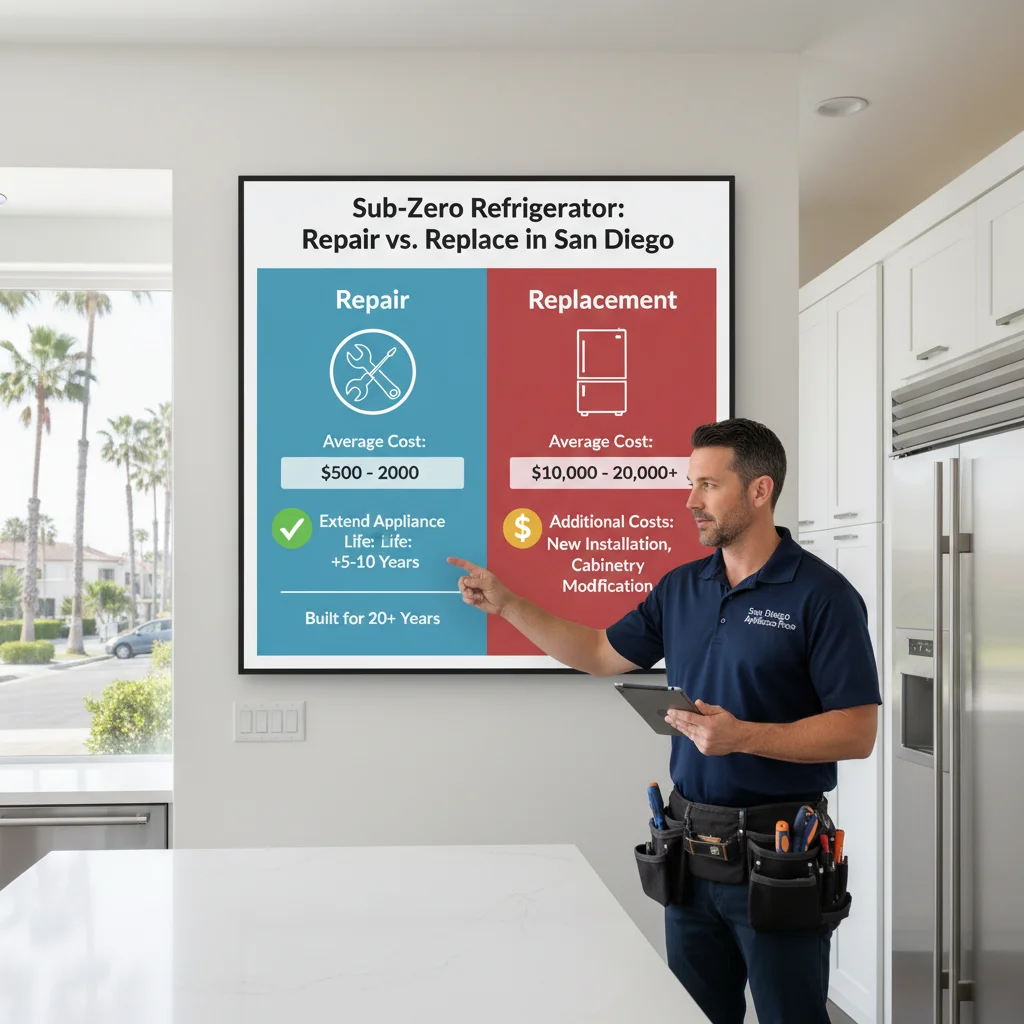
For most Sub-Zero owners, repair beats replacement. These units are built to run 20 years or longer, well past a standard fridge. A new Sub-Zero built-in costs many times more than a repair, before you even pay to pull the old one and fit the new one into existing cabinetry. A condenser cleaning, a new gasket set, an evaporator fan motor, or a control board is a fraction of that. Replacing also means measuring the opening, ordering a panel-ready unit, and timing the install around a cabinet shop. That’s weeks of a hole in your kitchen.
The compressor and sealed system are the heart of the unit, and on a Sub-Zero those are built to outlast everything around them. When the technician quotes a repair, they’ll tell you the unit’s age, what failed, and how much life the fix buys. If it’s a 700 series under 15 to 20 years old with a sound sealed system, repair is almost always the smart call. If the compressor is gone on a 25-year-old unit, the technician will say so. For the full breakdown, read our post on whether to repair or replace an appliance.
Sub-Zero service across San Diego County
When a Sub-Zero goes down, the clock starts on the food and the wine inside. If the box is warm or leaking, say so in the voicemail. Arrival times vary and we don’t promise one. Technicians in our network typically carry the parts that fail most: condenser fan motors, evaporator fans, door gaskets, water valves, and common control boards, which lets many repairs finish on the first visit instead of ordering and coming back. For built-ins, confirming the model on the phone means the technician brings the right gasket and panel hardware.
Booking is simple. Call us or send a request through the site, and we’ll set a time that works. For La Jolla, Del Mar, Rancho Santa Fe, and Fairbanks Ranch clients, we keep scheduling discreet and can leave a written report for the property manager or estate staff when no one’s home. You won’t get a tech who’s never opened a Sub-Zero. We cover all of San Diego County, from the coast in La Jolla and Del Mar to Poway and Rancho Bernardo inland, and from Coronado out to Escondido. For other appliance trouble, we also cover general refrigerator & freezer repair services across the area.
Frequently asked questions
Why does my Sub-Zero refrigerator run warm even though it’s on?
A clogged condenser is the most common cause. The condenser sits in the grille at the top of the built-in unit and packs with dust, pet hair, and cooking grease over time. A dirty condenser makes the compressor run hot and the box loses its ability to hold temperature. Cleaning the condenser coils and checking the condenser fan motor is often enough to bring the temperature right back.
What makes Sub-Zero refrigerators different to repair compared to standard models?
A Sub-Zero built-in runs two completely separate sealed systems, one for the fresh-food compartment and one for the freezer. A standard fridge uses one. That means twice the compressors, twice the evaporators, and twice the failure points. A tech who misreads which system is down can chase the wrong problem entirely. The 700 series, 600 series, Designer, and Pro models also route their wiring differently, so the repair requires the correct schematic for the specific unit.
Is it worth repairing a Sub-Zero, or should I replace it?
For most owners, repair is the clear choice. A new Sub-Zero built-in costs many times more than a repair before installation costs, and fitting a new unit into existing cabinetry adds weeks of coordination with a cabinet shop. Common repairs, such as a condenser cleaning, new gasket set, evaporator fan motor, or control board, are a fraction of that. If the unit is under 15 to 20 years old with a sound sealed system, repair almost always makes more financial sense.
What should I do if my Sub-Zero shows a blinking light or temperature error on the panel?
A failed thermistor or a control board that’s lost a sealed-system reading are the usual causes. Don’t ignore it. A warm compartment you’re not noticing yet can spoil food quickly, and opening a sealed system without confirming the diagnosis first can turn a sensor swap into a much larger repair. Call a technician who knows the model and can read both systems before touching anything.
When to call us
If your Sub-Zero is running warm, frosting up, leaking water, or showing errors on the panel, call before the food spoils. Opening a sealed system or swapping a control board without the right diagnosis can turn a small fix into a big one, and it can void coverage on the unit. Technicians in our network work on Sub-Zero every week and typically carry factory-authorized parts to do it right. Call us at (858) 988-7787 and we’ll get you matched with a technician.