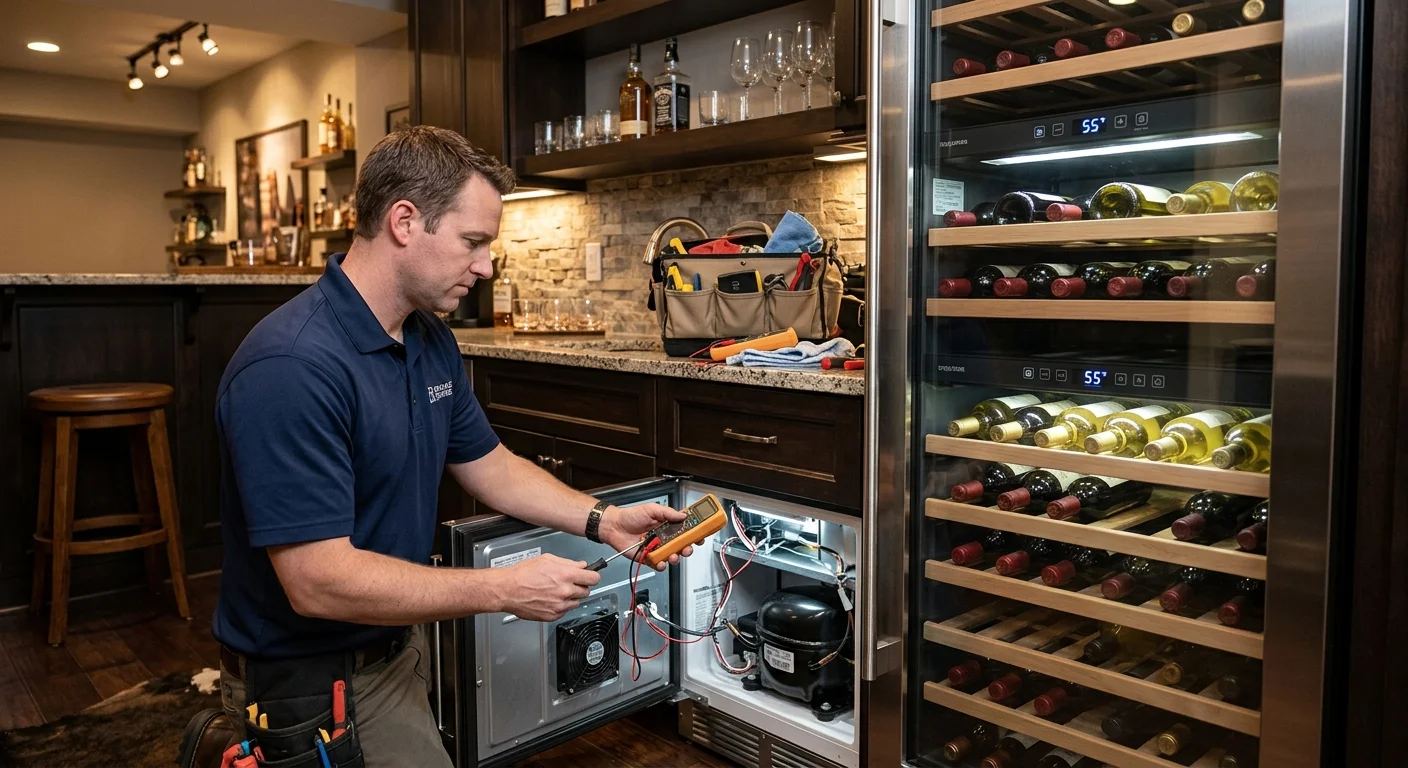
A wine cooler that drifts off temperature can cook a collection in a few warm days. We get these calls all over San Diego County. The unit won’t hold 55 degrees, it buzzes at night, or there’s water pooling under the door. Most of the time it’s a fan, a thermostat, or a worn door seal. Sometimes it’s the compressor or the cooling module. Either way, the technician diagnoses the exact part before quoting you anything.
Common wine cooler problems local techs fix
Our most frequent call is a unit that won’t reach its set temperature. Techs start by checking the obvious. Is the condenser coil packed with dust. Is the cooling fan still spinning. Does the door seal still pull shut. On dual-zone coolers, one zone often fails while the other holds fine, which usually points to a bad zone fan or a stuck damper. If the bottles feel warm and the inside walls sweat, the cold air isn’t circulating. We have a guide on what to do when your wine cooler isn’t cooling, but a hands-on diagnosis is the next step.
Noise is the second most common complaint. A compressor unit should hum low and steady. A thermoelectric unit should be nearly silent. A buzz or rattle usually means a fan blade hitting frost or a worn fan bearing. A clunk or hard knock on a compressor model can mean the compressor mounts are shot or the unit is short-cycling. Techs track the noise to the exact part instead of guessing. We’ve also written up wine cooler noises explained if you want the full breakdown.
Water on the floor scares people, and it should. Left alone it warps cabinetry and shorts the control board. On most builds the cause is a clogged defrost drain, a cracked drip tray, or a door gasket that’s lost its seal and lets warm humid air condense inside. The technician clears the drain, reseats or replaces the tray, and tests the gasket with a dollar bill before leaving. Techs in the network typically carry common gaskets, fans, and drain parts for the visit.
Compressor vs. thermoelectric wine cooler repairs
Understanding the type of wine cooler you own is key to effective repair. There are two primary technologies: compressor-based and thermoelectric. Each has distinct operating principles and, therefore, different repair considerations.
Compressor wine cooler repairs
Compressor wine coolers work much like a standard refrigerator. They use a refrigerant, a compressor, condenser coils, and an evaporator to cool the air. These models are powerful, offering a wider temperature range and faster cooling, making them ideal for larger collections or areas with warmer ambient temperatures, common in many parts of San Diego.
Common repairs for compressor models often involve:
- Compressor replacement: If the compressor fails, the unit won’t cool at all. This is a significant repair but often worthwhile for high-end units.
- Refrigerant leaks: A loss of refrigerant means insufficient cooling. Locating and sealing the leak, then recharging the system, is essential.
- Fan motor issues: Both evaporator and condenser fans are vital. If they fail, cooling is compromised, and the unit can overheat.
- Thermostat or control board malfunctions: These regulate temperature. A faulty one can lead to inconsistent cooling or complete failure.
Compressor work needs a gauge set, refrigerant recovery gear, and EPA certification to handle the refrigerant legally. The technicians in our network are trained on sealed systems and won’t open one unless the leak is fixable and the unit’s worth it.
Thermoelectric wine cooler repairs
Thermoelectric wine coolers run on the Peltier effect, pushing heat across a small solid-state module with electric current. They’re quiet, vibration-free, and gentle on a small collection. The tradeoff is ambient heat. A thermoelectric unit can only pull the inside about 20 to 30 degrees below the room. We see this fail in San Diego garages, sunrooms, and west-facing kitchens that bake in the afternoon. When the room hits the high 70s, the unit can’t keep up no matter how well it’s working. Half the “broken” thermoelectric coolers we check just need to move to a cooler spot.
Repairs for thermoelectric models are usually simpler:
- Thermoelectric cooling module replacement: This is the core component. If it fails, the unit stops cooling.
- Fan replacement: Thermoelectric units rely on fans to dissipate heat. If a fan fails, the module can’t cool effectively.
- Power supply issues: A faulty power supply can prevent the unit from turning on or cooling.
With no refrigerant and no compressor, these repairs are cleaner and usually cheaper. The module, the fans, and the power supply are the three parts that fail. The technician tests all three, then swaps whichever one’s dead and confirms the unit holds temperature before leaving.
Brands local techs repair: Vinotemp, U-Line, Marvel and more
Techs in the network work on wine coolers across San Diego County, from compact countertop units to built-in cellars in La Jolla, Rancho Santa Fe, and Del Mar homes. The high-end built-ins are their own animal. They’re framed into cabinetry, vented through tight kickplates, and each brand wires its controls differently. Techs come knowing how a given brand fails, not learning on your unit.
Techs in the network regularly work on popular and high-end brands, including:
- Vinotemp: Common in San Diego home bars. We see control board faults and dual-zone fan failures most often. Techs in the network handle Vinotemp repair in San Diego.
- U-Line: Premium undercounter and built-in units. The condenser sits behind the kickplate and clogs with dust, so cooling drops. Techs pull, clean, and service them in place for U-Line repair in San Diego.
- Marvel: Integrated columns with tight ventilation. When they overheat it’s usually a blocked vent or a tired condenser fan. Techs diagnose both.
- Sub-Zero & Wolf: The luxury built-ins we see most in coastal and inland-luxury homes. Sealed-system and control-board work on these needs brand-specific parts, which the technician sources before the visit when they can.
- KitchenAid, GE, Samsung, LG, Whirlpool: Mainstream coolers with shared parts platforms. Thermostats, door switches, and fan motors are the usual culprits.
- Danby, NewAir, Avanti: Compact and freestanding, mostly thermoelectric. Module and fan failures dominate, and ambient heat is often the real problem.
Techs in the network typically carry the common parts, gaskets, fans, thermostats, drain kits, and control boards, for the brands we see most. That’s how a lot of these close in one visit instead of ordering a part and coming back.
What to expect from our San Diego wine cooler service
Here’s how a wine cooler call goes when you book us. No mystery, no runaround.
- Scheduling: Call or book online. We’ll tell you a real arrival window, not “sometime today.”
- Diagnosis: The tech pulls the unit, checks the condenser, fans, thermostat, control board, and door seal, and reads the temperature at the sensor. On dual-zone models the tech tests each zone separately, then tells you the exact failed part.
- Written estimate: You get a written estimate before any work starts. Ask the technician about their diagnostic fee, the part cost, and the labor, all spelled out before anything else happens. No surprise line items.
- Repair: Most fixes happen on the spot with parts techs typically carry, a fan, a thermostat, a gasket, a drain kit. Sealed-system and special-order brand parts are the exceptions, and the technician will tell you that day. The technician completes your wine cooler repair and stands by the work.
- Testing: The technician runs the unit and watches it pull down to your set temperature and hold it before packing up. On a built-in, they reseat it in the cabinet and confirm the vent path is clear, then clean up.
- Warranty: Warranty terms come from the tech who does the work, so ask before you approve the quote. If the same fault comes back inside that window, the tech comes back.
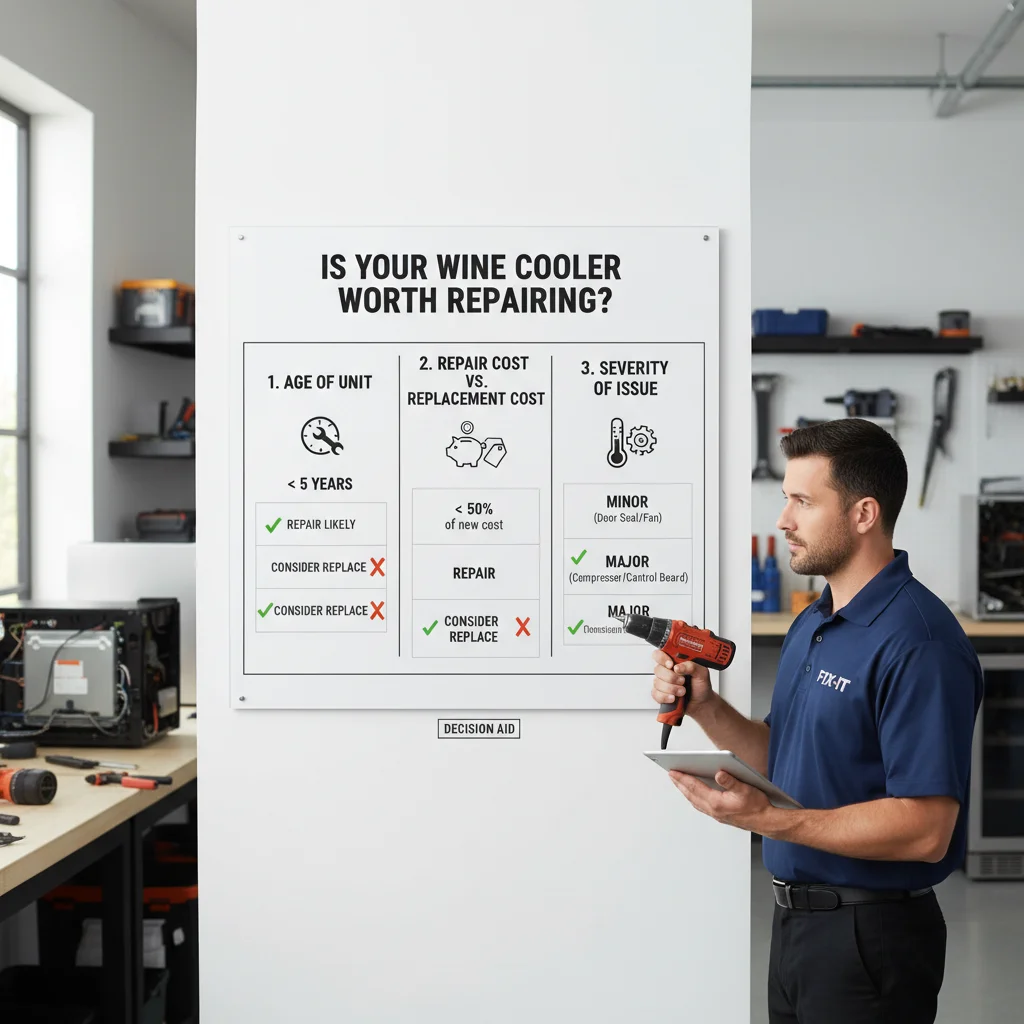
When is a wine cooler worth repairing?
Not every wine cooler is worth fixing, and we’ll tell you straight when it isn’t. Here’s how we think through it on a service call.
Age of the unit:
- Newer units (under 5-7 years old): For most wine coolers, especially high-end models, repair is almost always the more economical choice. Components are still widely available, and the unit likely has many years of life left.
- Older units (over 10-12 years old): As units age, parts become harder to find, and the appliance might be less energy-efficient than newer models. If the repair cost is significant (more than 50% of a new unit’s price), replacement might be smarter.
Cost of the repair: Techs provide transparent repair estimates, letting you weigh the cost against a new purchase. If the repair is minor and inexpensive, it’s typically the way to go. For major components like a compressor, the cost can be higher, making the decision more complex. Consider the original investment you made in the wine cooler; a higher-end unit is worth a more expensive repair than a budget one.
Energy efficiency: Older wine coolers can consume more energy. While repairing an old unit might save you money upfront, a new, energy-efficient model could save you more over time on your utility bills. The California Energy Commission offers resources on appliance efficiency that can help inform your decision.
Overall condition and features: One failed part on a solid unit is an easy yes. A built-in framed into custom cabinetry is also worth more repair, since replacing it often means a cabinet job too. But if the compressor’s dead on a cheap freestanding unit, or several parts are failing at once, replacement usually wins. The technicians in our network give you an honest read on the unit’s overall health so you can decide.
Frequently asked questions
What are the most common wine cooler repairs in San Diego?
The most frequent call is a unit that won’t reach its set temperature, usually traced to a dirty condenser coil, a failed cooling fan, or a worn door seal. Noise complaints, typically a buzzing fan or a rattling compressor mount, are the second most common. Water on the floor, caused by a clogged defrost drain or a cracked drip tray, rounds out the top three.
Can a thermoelectric wine cooler be repaired?
Yes, and repairs are usually simpler and less expensive than compressor-model work. The three parts that fail are the thermoelectric cooling module, the fan, and the power supply. There’s no refrigerant involved, so the repair is cleaner. That said, half the thermoelectric coolers we check in San Diego aren’t broken; they’re just placed in a room that gets too warm, since these units can only cool about 20 to 30 degrees below ambient.
How do you handle built-in wine cooler repairs?
Built-in units framed into cabinetry need to be serviced in place, which means the technician pulls the unit out through the front opening, does the work, then reseats it and confirms the vent path is clear before leaving. Techs in the network typically carry common parts like gaskets, fans, thermostats, and drain kits, so most built-in calls close in a single visit.
How do I know if my wine cooler is worth repairing?
Age and repair cost together tell the story. A unit under five to seven years old is almost always worth fixing if the repair is a single component. Older units past 10 to 12 years, or any unit where the repair exceeds 50 percent of a new cooler’s price, often make more sense to replace. A high-end built-in framed into custom cabinetry is worth more repair investment, since replacing it usually means a cabinet job too.
When to call us
If your cooler won’t hold temperature, buzzes or rattles, or leaks water, get it looked at before your bottles take the hit. Cracking open a sealed system or rewiring a control board yourself is how a small fix turns into a new unit. Techs in our network handle this every week across San Diego County. Call us at (858) 988-7787 to get matched with a technician.