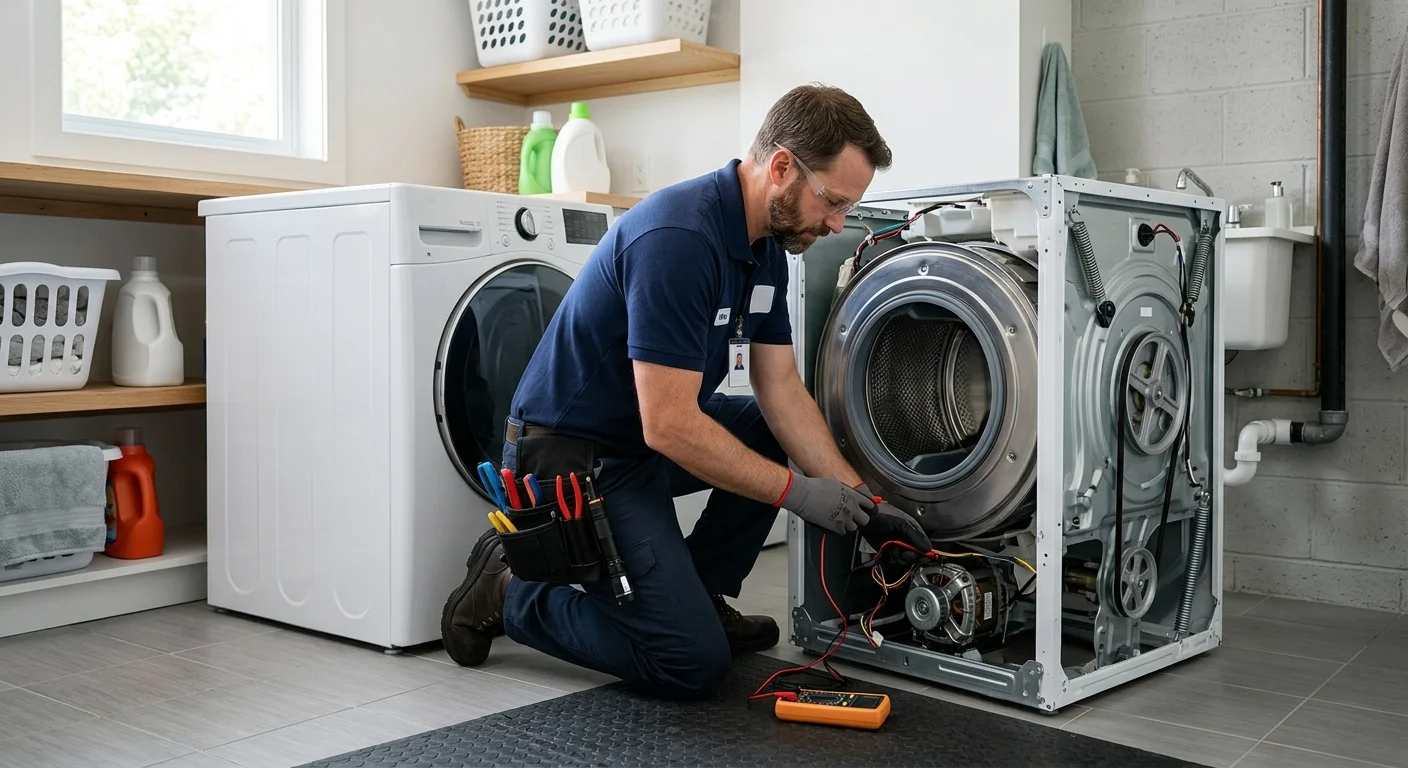
A Duet in a San Diego laundry closet fills, tumbles, then never climbs into a real spin. The load comes out heavy, and the cycle looks finished on the console. That is a front-load spin-stage failure, and it is a different machine than a top-load Whirlpool that will not spin.
Confirm a Duet model and the failed spin stage
A Duet is a Whirlpool front-load washer. The door is on the face of the cabinet. The drum is a horizontal tub. Many sit on a pedestal or stack with a matching dryer in a closet. That layout is common in Encinitas, Carlsbad, Pacific Beach, and downtown condos, where laundry is a stacked closet, not a garage alcove.
Confirm the model before you describe the fault. Open the door and look for the tag on the frame. Many Whirlpool front-loaders use a WFW prefix. The glass or console may still say Duet. Photograph the full model and serial. A matched technician needs those characters, not a guess from the door color.
Then name the stage that failed. A Duet cycle is not one motion. It fills. It tumbles the load in water. It drains. The door lock has to stay confirmed. The control checks that the tub is not badly out of balance. Only then does the motor ramp into a true spin.
Write down what actually happened. Water entered and the drum tumbled, then the cycle ended with a soaking load. The drum never turned at high speed, and you can still hear water slosh. The door stayed locked long after the cycle should have finished. The display showed a code, went blank, or sat in a paused-looking state.
That last line matters. A lock that never releases is not the same job as a tub that is already empty and still will not accelerate. A Whirlpool washer error code is a clue, not a parts order. Copy the exact characters. Do not clear them until they are written down.
This page stays on units that fill or tumble and then skip or abort spin. It is not a start-up failure, not a leak walkthrough, and not a top-load lid-switch story. If the washer is a Cabrio or another top-loader, use the top-load guide instead. If you are comparing laundry types, front-load versus top-load explains why a Duet even needs that high-speed spin.
San Diego housing changes the setup around the machine. Coastal closets run tight. Stacking kits and pedestals shift if the floor is not flat. East County laundry rooms in El Cajon and Santee pick up more dust. South Bay homes in National City and Chula Vista often have older hose stub-outs and a single laundry outlet. None of that diagnoses the motor. It does tell the technician how the Duet is sitting and how it drains.
What owners can observe without opening the washer
You can learn a lot without removing a panel. Unplug the washer first if you are going to slide it even an inch. Keep the door shut until the tub has stopped. Do not reach into a drum that might still move.
Stand in front of the glass and run a short cycle with a small, even load. Use a drain or spin-only option if the console offers one. Watch four things: fill, tumble, drain, and the last minutes of the cycle.
If the drum tumbles during wash, the motor can still move the tub at low speed. A later no-spin is then less likely to mean a dead motor. It is more likely a lock, drain, balance, or control decision that blocks the ramp.
Look at the floor and the door glass. Standing water at the end of the cycle means spin never had a clear tub. A wet load with an empty-looking glass can still hide water below the bellows. Listen for the drain pump. A pump that never starts, a pump that hums, and a pump that runs with no water leaving the hose are three different notes.
Check the path the water has to take. The drain hose should not be kinked behind a stacked pair. In many North County closets the hose is crushed between the cabinet and the dryer vent. Confirm hose height and kinks with your eyes. Do not cut or re-route the hose as a repair.
Look at the door. A Duet will not spin with a lock that never confirms. If the latch is broken, the striker is bent, or laundry is caught in the boot, the control may tumble and then quit. Coastal humidity in La Jolla, Mission Beach, and Imperial Beach also grows film on the door boot. That film is a smell and seal problem. It is not, by itself, proof of a failed bearing. Our notes on front-loader mildew cover the owner-facing cleaning, not a spin diagnosis.
Note the load. One heavy blanket in a front-loader is a classic abort. Mixed towels and a rug will walk the tub. The control may try, fail the balance check, and skip the fast spin. Redistribute and try once. Repeated aborts on a normal mixed load are a different story.
If you just moved the washer, look for shipping bolts still in the rear cabinet. A Duet that still has those bolts cannot spin the way it was designed to. That check is visual. It does not require opening the inner tub.
Power is the last owner check. Confirm the unit is plugged into the laundry outlet, not a tired extension cord. If a GFCI or breaker has tripped, reset it once and see whether the console comes back. Repeated trips are an electrical problem for a technician, not a DIY reset loop.
How drain and control symptoms narrow the complaint
Drain and control symptoms split this complaint in half.
If water remains, the Duet is doing what many front-loaders are programmed to do. It will not command a high-speed spin on a tub that has not drained. The job then starts as a drain problem. Hair, coins, and lint collect in the pump trap on these units. Hard water inland from Escondido through El Cajon leaves scale on screens and in the sump. A crushed drain hose behind a stacked closet in Oceanside or Pacific Beach can look like a dead pump. Our washer won’t drain notes cover the owner-facing drain checks. Stay outside the cabinet.
If the tub is empty and the load is still soaked, the control got past fill and wash, then refused or failed the spin ramp. That points at the door lock circuit, a speed sensor that never reports rotation, a drive system that cannot accelerate, or a control that never issues the command.
Watch the display the whole time. A code that appears at the drain step is a drain or lock clue. A code that appears only when the drum should accelerate is a spin-path clue. Copy it exactly and read it against the error-code page. Do not treat a code as a parts list. The same character set can mean a clogged pump on one visit and a failed lock on another.
Listen for the lock. Many Duets click at the door at the start of spin. No click, then no spin, is a lock or lock-circuit lead. A click, then a short growl, then silence, is more of a motor or drive lead. A click, a pump-out, a pause, and a cancel is often a balance or water-level decision.
Control Lock, Delay Start, and a paused cycle fool people. Confirm those settings are off. A console that is dead, flickering, or missing segments is a control or power issue, not a drum issue.
Do not hold the door closed with a shim. Do not tape the lock. The lock is a safety interlock. Defeating it is how a spinning drum meets an open door.
What technicians inspect on front-load Duet units
The technician you are matched with works from those outside clues, then tests. Repair Pro San Diego does not send a brand truck and does not stock parts. The independent pro does the inspection.
On a front-load Duet, that inspection usually starts at the door lock and the striker. The tech confirms the lock actually latches, that the circuit closes, and that the control sees it. A tumble with no spin often dies right there.
Next is the drain path: pump, trap, sump, and hose. A Duet that cannot finish drain will keep aborting spin even with a healthy motor. Water-level sensing follows. If the control still thinks the tub is full, it will not spin. That can be a pressure hose off the port, a blocked air tube, or a failed sensor. The tech checks. It is not an owner squeeze-test.
Then the drive. Motor, the coupling or belt on that WFW generation, and the speed feedback. Low-speed tumble with no high-speed ramp is a classic split. The motor can move the tub, but something in the high-speed path fails. Suspension is next. Shocks and springs. A Duet on a pedestal in a Hillcrest or La Mesa closet will walk if a shock is gone. The control then refuses spin to protect the tub.
The boot and the rear bearing come in if the complaint includes grinding, a burning smell, or rust-colored streaks at the back of the drum. Those are not watch-and-wait noises. Wiring at the tub and at the lock gets a look too. Vibration behind a stacked pair breaks harnesses. The control is last, after the mechanical path is tested. Boards get blamed early. On these machines they are rarely the first test.
The pro should also look at how the machine sits in a San Diego laundry space. A stacking kit that is loose, a pedestal that is not lagged, and a floor that slopes toward a hallway all change vibration. Coastal salt air is hard on exposed fasteners and on the boot. Inland heat in Escondido and Spring Valley cooks a laundry closet that has no airflow.
Ask for the findings in writing before any repair starts. Ask whether the diagnostic visit is credited toward the work. That is the technician’s fee policy, not a brand price list. California consumers can confirm a repair business’s registration with the Bureau of Household Goods and Services lookup. Registration is a dealer status check. It does not grade a technician’s skill.
If the unit is still under the manufacturer’s written warranty, say so up front. Under California’s Song-Beverly Consumer Warranty Act, a manufacturer that makes an express warranty must complete warranty repairs within 30 days unless the delay is beyond its control. Coverage still comes from the written warranty, not from this page.
When to request Whirlpool washer repair
Request Whirlpool washer repair when the owner checks are done and the Duet still will not complete spin. One redistributed load is a fair retry. A second soaked load on a normal mixed wash is enough.
Ask for a match sooner if you smell burning plastic, hear grinding metal, see water at the boot, or if the door will not unlock. Those are not run-it-one-more-time symptoms. Standing water in a second-floor laundry closet in Pacific Beach or downtown is also a neighbor problem, not only a spin problem.
Skip cabinet teardown. Front-loaders store voltage in controls, and the door lock is there so you are not reaching into a drum that can still move. If a recall check is on your mind, search the model on the CPSC recall list.
This brand matches you with a licensed, insured local pro for washing machine repair. The matched technician diagnoses, quotes in writing, and does the work. There is no brand parts shelf and no brand warranty on the repair. The technician’s warranty, if they offer one, is the one that applies.
Cost talk belongs on a diagnosis, not on a guess. This site has no washer price list, and a specific San Diego average would be an invented statistic. What moves a job is the failed part, cabinet access on a stacked pair, and whether the tub, bearing, or control is involved. Ask the matched tech to quote before work begins. For broader cost context, see our washing machine repair cost notes, then treat those as a starting conversation, not a bill.
If you are weighing repair against a new set, use condition and repeated failures, not a made-up year cutoff. ENERGY STAR lists current washer ratings if you are shopping. This page will not invent a lifespan for a Duet washer or a Duet dryer.
When you request whirlpool duet washer repair, have the model number, the cycle that failed, whether the tub drained, whether a code appeared, and whether the washer is stacked. That packet is what makes the visit a real diagnosis instead of a second guess.
When to call us
A Duet that fills or tumbles and then never completes spin needs a licensed appliance repair pro at the machine, not a parts guess from the internet. Repair Pro San Diego matches San Diego County homeowners with independent technicians. Call (858) 988-7787 to leave a voicemail requesting a match with a local appliance repair pro.