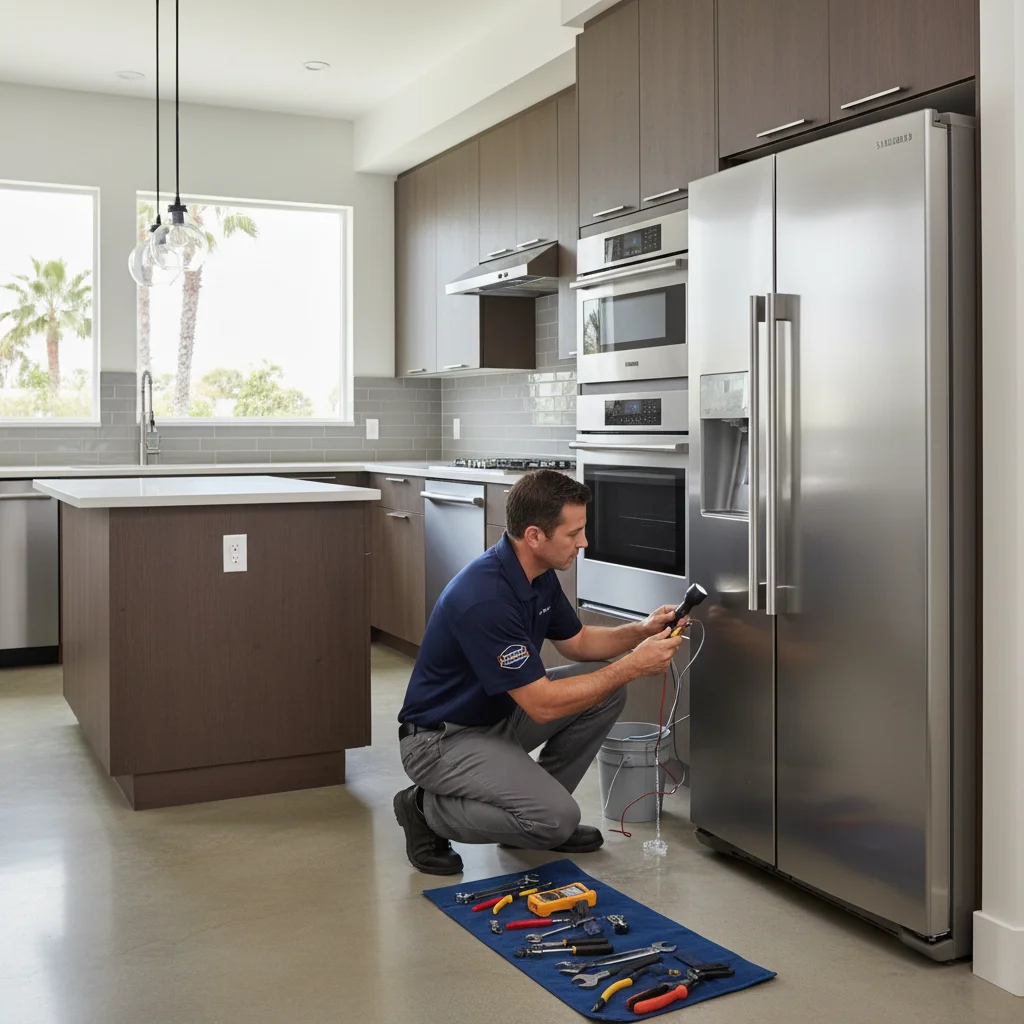
Samsung makes some of the most common appliances in San Diego County kitchens and laundry rooms. They also fail in predictable ways. The technicians in our network see the same Samsung problems week after week, from Carmel Valley to Chula Vista. Ice makers that freeze solid. Washers throwing drain codes. Fridges where one side cools and the other doesn’t. This post covers the failures we see most, what causes them, and what a tech checks first.
Why we’re San Diego’s choice for Samsung repairs
Samsung runs a lot of proprietary parts and firmware. The diagnostic codes don’t always match other brands. Twin Cooling fridges use two separate evaporators and fans, so a cooling fault on one side tells you exactly where to look. The Family Hub models add a touchscreen, cameras, and a Wi-Fi board that can fail on their own without touching the cooling system. If a tech doesn’t know those differences, it’s easy to swap the wrong board and still have a broken fridge.
Techs in our network work on Samsung machines all the time, so they know the patterns. They pull the model and serial off the sticker, check it against known design issues, and read the live data before condemning a part. On a no-cool fridge, that means testing the defrost heater, thermistor, and evaporator fan instead of guessing. On a washer, it means reading the error history in test mode, not just the code on the display.
Techs in our network carry the parts that fail most on the truck: evaporator fan motors, defrost sensors and heaters, drain pumps, door switches, and main control boards. Having the common parts on hand means a lot of these finish in one visit. The network covers the whole county, from Escondido and Vista down to Coronado and Chula Vista, plus the coast and the inland valleys in between.
The infamous Samsung ice maker issue (and how it gets fixed for good)
If you searched “Samsung ice maker not working,” you’re in good company. This is one of our most common calls, and it hits the French door models hard, the RF series in particular. The ice maker sits in the fresh food compartment, which is the root of the problem.
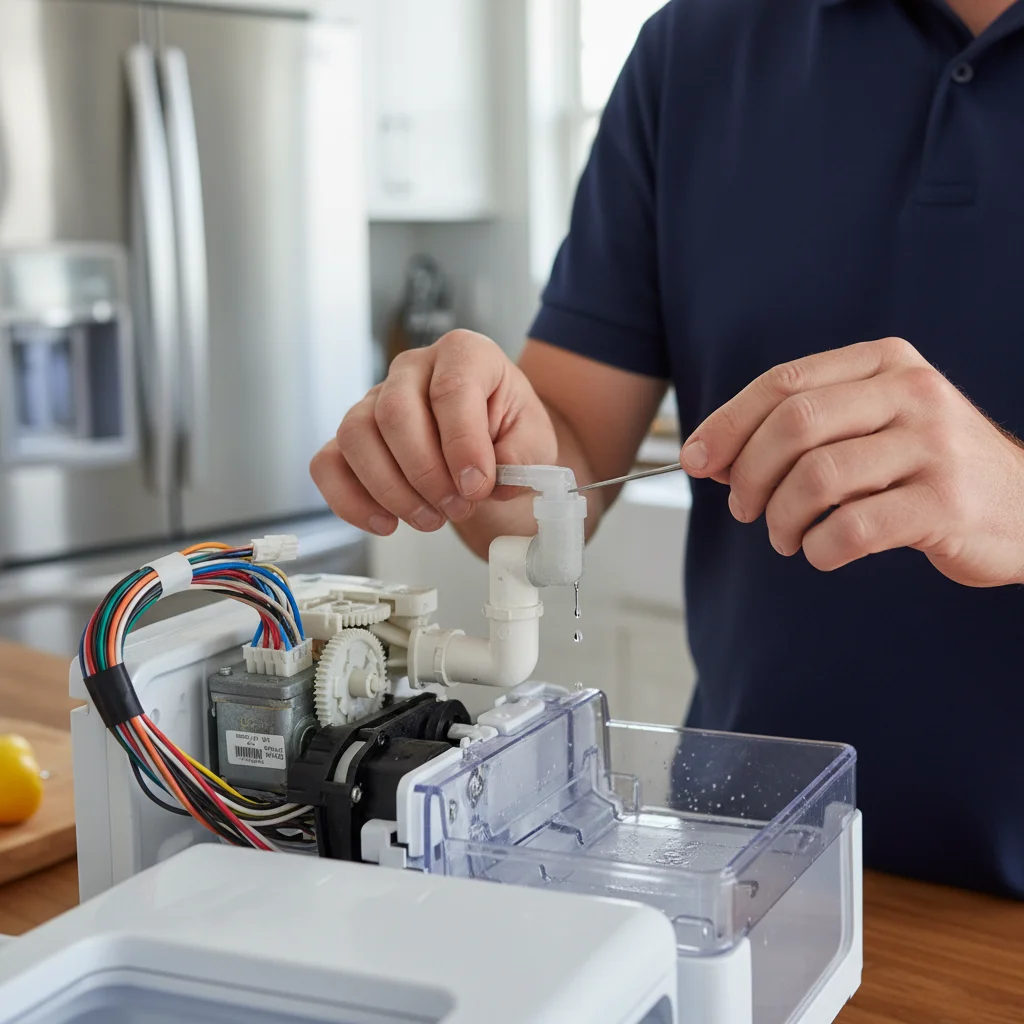
The signs follow a pattern. Ice production slows down first. Then you hear the fan ticking or grinding as it hits ice. The bucket fuses into one solid block. Sometimes you get a sheet of frost across the back of the ice compartment, or water dripping into the fridge below it. By the time most folks call, the auger won’t turn at all.
The cause is frost building up inside the ice maker compartment. Warm, humid air leaks past the seals around the ice maker housing. That moisture freezes on the evaporator and fan instead of draining off during the defrost cycle. Coastal San Diego humidity makes it worse, so we see this a lot in beach-area homes from Pacific Beach to Encinitas. Thawing it with a hairdryer buys you a few weeks. The frost comes right back because the air leak is still there.
The techs in our network don’t just melt the ice and leave. They go after the air leak and the defrost so it stops coming back. Depending on the model, that involves:
- Installing an updated evaporator cover and fan assembly.
- Sealing all air gaps with food-grade silicone to prevent warm, moist air from entering.
- Replacing and repositioning temperature sensors for more accurate readings.
- Installing updated drain tubes that prevent refreezing.
Fixing the air leak and the defrost together is what makes the repair hold. If you’re tired of chipping ice out of the bucket every month, book a professional ice maker repair that goes after the cause, not the symptom.
Common error codes on Samsung washers and dryers
Samsung washers and dryers flash a code when something’s wrong, but the code only points at a system, not the exact part. A drain code can mean a clogged filter or a dead pump. Here are the codes we see most on Samsung laundry in San Diego, what they mean, and what you can safely check yourself first.
Samsung washer error codes
5E,nd, or5C(Drainage Error): This is the most frequent washer issue. It means the machine is unable to drain water effectively. Before calling us, you can check the small debris filter, usually located on a small door at the bottom front of the machine. If that’s clear, the problem is likely a clogged drain pump or a blockage in the drain hose, which requires a technician to resolve.dC,UE, orUb(Unbalanced Load): This code signals that the load is unbalanced, and the washer can’t spin safely. Try redistributing the clothes. If it persists even with a balanced load, it could point to failing suspension rods or shock absorbers that are no longer keeping the drum stable.LEorLC(Water Leak Error): The machine’s sensors have detected water where it shouldn’t be. This could be due to too much detergent causing over-sudsing, a loose hose connection, or a crack in an internal component. This requires immediate attention to prevent water damage.
If the code comes back after you’ve checked the filter and rebalanced the load, the part has failed. Our samsung washer repair san diego techs put the machine in test mode, read the live sensor data, and pin down whether it’s the pump, the pressure sensor, or a board. A proper washing machine repair beats living with a washer that won’t drain or spin.
Samsung dryer error codes
hEorHE(Heating Error): The dryer tumbles but the clothes come out damp. On an electric dryer this is usually a burned-out heating element or a blown thermal fuse. A technician tests the element for continuity and checks the fuse before replacing anything. A clogged vent line can trip this too, so the duct run gets checked while they’re there.tSortE(Temperature Sensor Error): The thermistor that reads drum temperature has drifted or failed. The dryer then overheats or stops heating to protect itself. A technician tests the sensor’s resistance against spec and replaces it if it’s out of range, which gets the heat regulating correctly again.
Samsung refrigerator and freezer problems we see most often
The ice maker gets the headlines, but Samsung fridges fail in a few other ways we see all the time. The Twin Cooling Plus system runs separate cooling for the fridge and freezer, which works well until one side quits and the other keeps humming along.
One of the most common calls we get for samsung refrigerator repair san diego is for a fridge that’s not cooling while the freezer is still cold (or vice versa). In a Twin Cooling system, this almost always points to a problem with the specific fan or defrost system dedicated to the fresh food compartment. The coils behind the back panel can freeze over, blocking airflow. The technicians in our network can access this area, test the defrost components (heater, thermostat, and sensor), and replace the faulty part to restore proper airflow and temperature.
Another frequent issue is water pooling at the bottom of the fresh food compartment or under the crisper drawers. This is a classic symptom of a clogged defrost drain. Over time, debris can clog the drain tube that carries water from the defrost cycle to the evaporator pan. When it’s clogged, the water backs up and freezes, eventually overflowing into the fridge. We have specialized tools to quickly and safely clear these lines without damaging the refrigerator’s internal components.
Finally, we address unresponsive touch panels and blinking displays. Sometimes this is a simple fix requiring a system reset, but it can also indicate a failing main control board. We can accurately diagnose whether the display board or the main board is the culprit, preventing you from paying for an unnecessary part. For any of these issues, a prompt refrigerator repair is essential to save your food and prevent further damage.
What to expect when you book a Samsung repair with us
A dead fridge or washer throws off your whole week. Here’s how a Samsung repair runs with us, start to finish.
- The first call: We ask for the model and serial number off the appliance sticker, plus what it’s doing or not doing. On a fridge the sticker’s inside on the left wall. On a washer it’s around the door opening. That number lets us check the model against known Samsung issues and load the likely parts before the tech leaves the shop.
- Scheduling: We give you an arrival window instead of an all-day wait. The tech calls or texts when they’re headed your way, so you’re not stuck home guessing.
- On-site diagnosis: The tech reads the live data and error history in test mode, checks the suspect parts against spec, and finds the actual failure. You get the diagnosis in plain terms and a written quote before anything gets opened up.
- The repair: With your okay, the tech does the work, then runs the appliance through a full cycle to confirm it’s fixed. They reassemble it, test it, and leave the area clean. Warranty terms come from the tech who does the work, so ask before you approve the quote.
The point is no surprises. You know the problem, the price, and the timeline before we turn a screw.
Frequently asked questions
Why does my Samsung ice maker keep freezing up?
The root cause is warm, humid air leaking past the seals around the ice maker housing. That moisture freezes on the evaporator and fan during the defrost cycle instead of draining off, and coastal San Diego humidity makes it worse. Melting it with a hairdryer is a temporary fix; the air leak has to be sealed and the defrost system corrected for the repair to hold.
What does a Samsung drain error code mean on a washer?
The 5E, nd, or 5C codes all mean the machine can’t drain. Start by checking the debris filter behind the small door at the lower front of the machine. If that’s clear, the problem is a clogged drain pump or a blockage in the drain hose, both of which need a technician to resolve.
Can I reset a Samsung refrigerator that won’t cool?
A soft reset (holding the Power Freeze and Power Cool buttons for five seconds) clears minor firmware glitches. If the fridge still won’t cool after a reset, the real fault is likely a frozen evaporator coil, a failed defrost component, or a faulty fan, all of which need a diagnosis from the live sensor data in test mode rather than more resets.
Do Samsung appliances use proprietary parts that are hard to find?
Some components, especially evaporator fan assemblies and defrost sensors for Twin Cooling models and Family Hub control boards, are Samsung-specific and not found at general parts counters. The technicians in our network stock the highest-failure Samsung parts on the truck, which is how most repairs finish on the first visit.
When to call us
Clearing the debris filter or rebalancing a load is fine to do yourself. But once you’re into the sealed cooling system, a control board, or a heating element, you’re dealing with refrigerant lines and live electrical. A wrong move there can turn a small fix into a new appliance. That’s where you call us. If the code keeps coming back, the fridge won’t cool, or the dryer won’t heat, we’ll handle it.
Call us at (858) 988-7787 to get matched with a local technician.