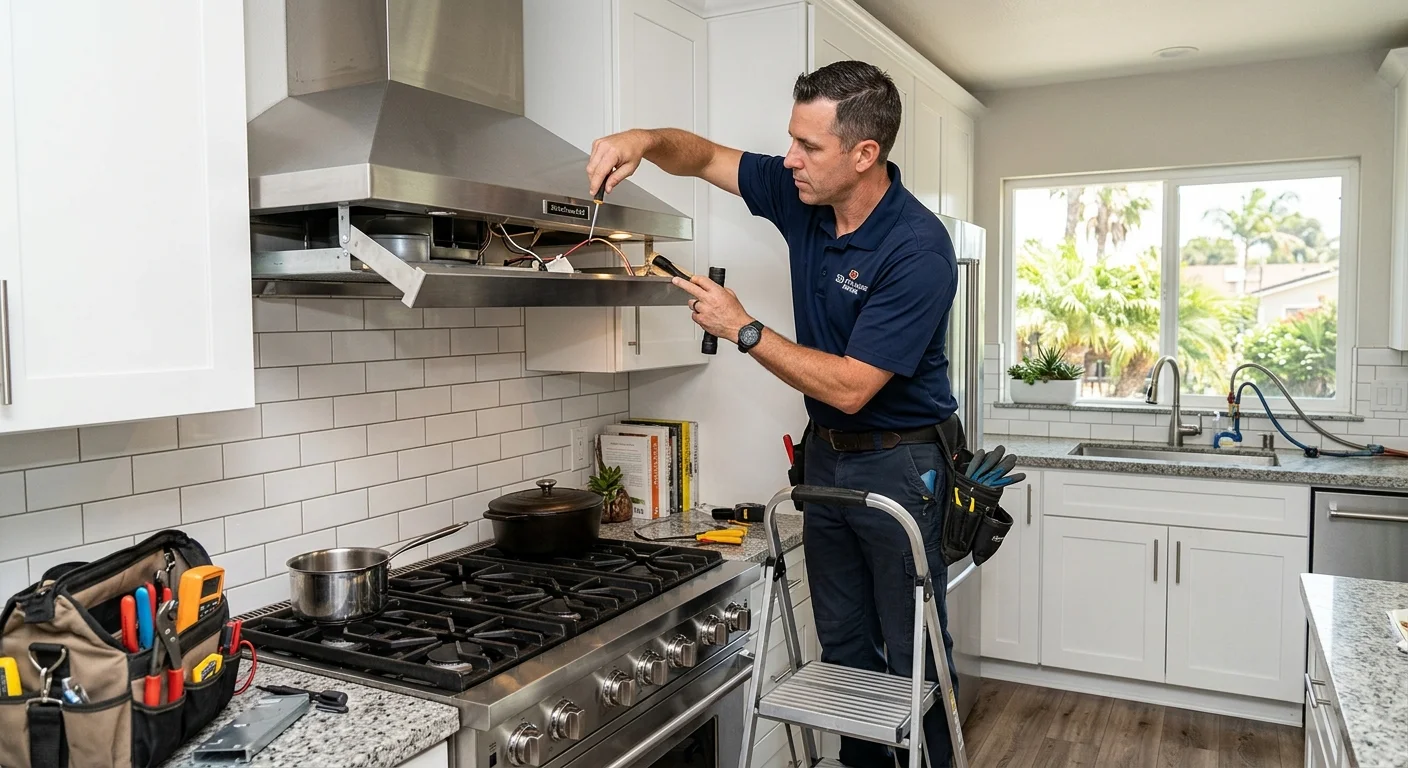
When a range hood quits, smoke and steam have nowhere to go. The fan won’t spin, the lights stay dark, or the blower screams every time you cook. That hood pulls grease and moisture out of your kitchen air. When it fails, that grease settles on your cabinets and ceiling instead.
Range hoods across San Diego County fail in predictable ways every week. Most calls come down to a handful of parts: a dead blower motor, a failed switch, a clogged filter, or a duct that’s packed with grease. The techs in our network have seen all of it. Here’s how a technician diagnoses each problem and what it usually takes to get your hood moving air again.
Is your range hood fan not working or too loud?
A blower that won’t spin, runs slow, or roars is the most common range hood call. Most range hoods use a squirrel-cage blower, not a propeller fan. That cage packs full of grease over time, and the extra weight drags the motor down. The first thing a technician checks is whether the motor hums but won’t turn. That usually points to a seized bearing or a bad start capacitor on higher-CFM models.
If the motor’s dead silent, the technician tests for power at the motor leads. No power there means the problem is upstream: a failed rocker switch, a cracked solder joint on the control board, or a broken wire at the connector. If power reaches the motor and it still won’t move, the motor’s done and needs to be swapped.
Loud hoods almost always come down to three things. Worn motor bearings make a steady grinding whine. A blower wheel caked with grease throws itself off balance and rattles. And a wheel that’s loose on the motor shaft slaps the housing on startup. The technician pulls the wheel, cleans or replaces it, and checks that the motor mounts haven’t gone soft. Run a screaming hood long enough and you’ll cook the motor windings, so it’s worth catching early.
Common range hood problems and what they mean
The fan isn’t the only thing that breaks. Here’s what the other common symptoms mean for a range hood repair.
- Lights not working: Start with the bulb. Many hoods use small halogen puck lights or G9 bulbs that burn out fast above a hot stove. Newer models run LED strips or LED modules wired to a small driver. If a fresh bulb does nothing, the technician tests the socket contacts, the light switch, and the LED driver. On halogen hoods the technician also checks the transformer that steps voltage down for the bulbs.
- Poor suction: A running hood that won’t clear smoke usually has a grease-soaked filter choking the airflow. The technician pulls the aluminum mesh filters and checks them first. On ducted hoods that means looking for a stuck backdraft damper, a crushed or kinked duct run, or a vent cap on the roof or wall that’s painted shut or blocked. On ductless hoods, a saturated charcoal filter kills suction even when the blower’s fine.
- Excessive noise: Past the motor, the technician checks the blower wheel for grease imbalance and a loose set screw on the shaft. A backdraft damper flapping in the wind makes a clatter. Undersized or too-long ductwork creates a low rumble or whistle as air fights through it.
- Controls not responding: Sticky buttons or a dead touch panel point to a failed control board or a flex-cable connection that’s corroded. Grease and steam creep behind the panel and eat the contacts over time. The technician tests the board and the membrane switch before replacing anything.
- Hood completely dead: Check the breaker and the plug first. If it has power and still won’t wake up, the technician tests the incoming voltage at the hood, then the control board. On a hardwired hood the technician also checks the wire nuts in the junction box, since a loose connection there kills the whole unit.
Catch these early and you avoid a small problem turning into a fried motor or a smoke-stained ceiling. If you’ve already tried the basics and your range hood is still not working, give us a call.
Ducted vs. ductless range hood repair
Knowing which system you have changes how a technician diagnoses it. San Diego kitchens run both. Older homes in North Park and La Mesa often hide a ductless hood under the cabinets, while newer builds in Carlsbad and Chula Vista usually vent outside.
Ducted range hoods
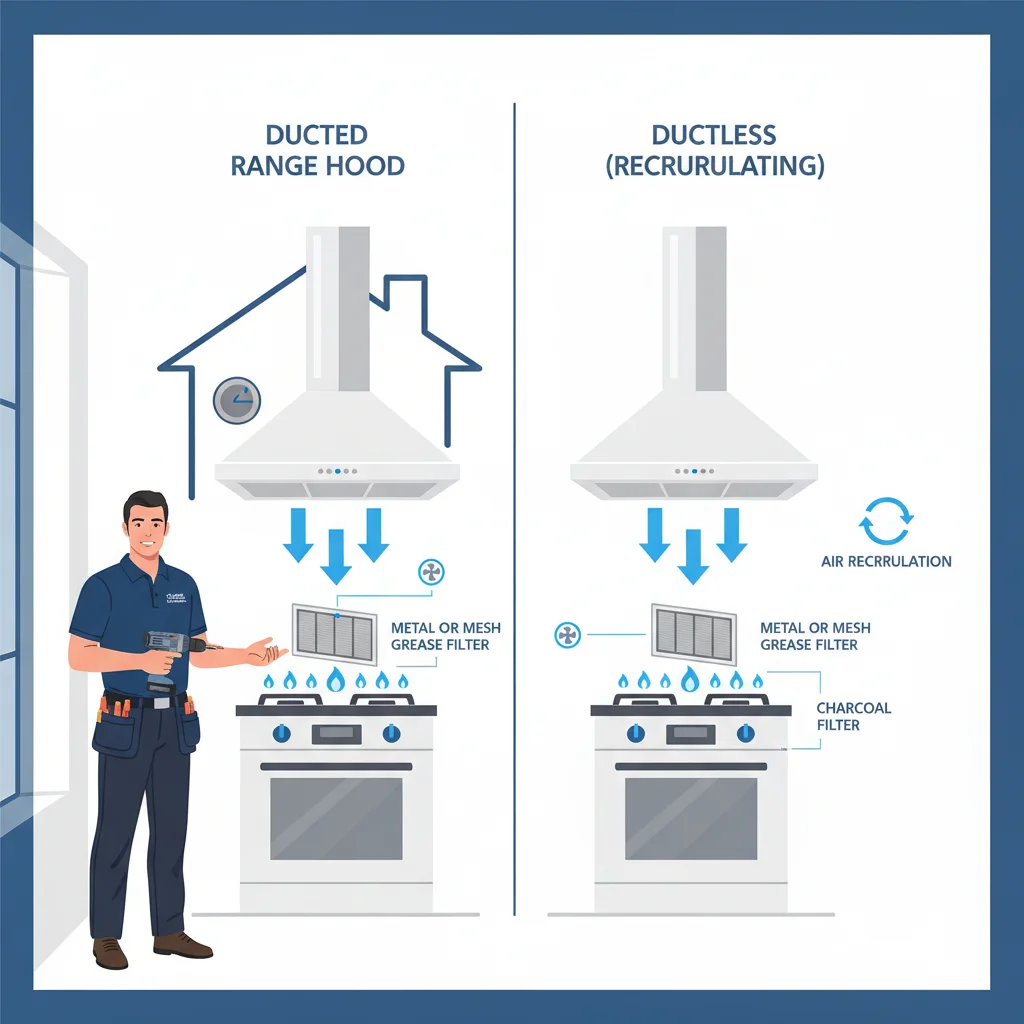
A ducted hood pushes smoke and steam outside through a duct in the wall or ceiling. When suction drops on one of these, the technician traces the whole path. That starts with the backdraft damper inside the hood, since a grease-stuck damper won’t open and traps the air. Then the duct run for crushed sections or sharp bends that choke airflow. Then the vent cap outside, where bird nests, lint, or a flap rusted shut are common finds. The technician also checks that the duct stays sealed at the joints, because a leak dumps greasy air into your attic instead of outside.
Under-cabinet models hang below a cabinet and usually vent up through a short duct. Wall-mount and island hoods, plus pro-style chimney hoods, push more air and run higher-CFM blowers, so their motors and ducts work harder. The bigger the airflow rating, the more it matters that the duct is sized right and the vent cap is clear.
Ductless (recirculating) range hoods
A ductless hood, also called a recirculating hood, doesn’t vent outside. It pulls air through a charcoal filter to strip odors, then blows the cleaned air back into the kitchen. These have two filters that matter: the metal mesh grease filter you can wash, and the charcoal filter you replace. When a ductless hood loses suction, the charcoal filter is the first suspect. It packs solid and the blower can’t push air through it. Most need a fresh charcoal filter every three to six months if you cook a lot.
The blower motor and switches on a ductless hood fail the same way they do on a ducted one. The difference is there’s no duct or vent cap to chase, so the fix lives inside the hood. The technician tests the motor, the switch, and the board, then swaps the filters while in there.
Tell us which type you have when you call, and the technician will bring the right parts. Whether it’s a charcoal filter swap or a full motor replacement, techs in the network typically carry common range hood components on their trucks.
Brands covered in San Diego County
The techs in our network work on range hoods from most major brands, and each one has its quirks. Vent-A-Hood uses its own blower design that needs a specific cleaning approach. Broan-NuTone makes the motors and blower wheels behind a lot of builder-grade hoods, so parts are easy to source. Zephyr and Bosch lean on touch controls and LED lighting that fail differently than old rocker-switch hoods. Here’s what shows up most:
- Whirlpool
- KitchenAid
- Samsung
- LG
- Bosch
- Frigidaire
- GE
- Maytag
- Kenmore
- Vent-A-Hood
- Broan-NuTone
- Zephyr
- Plus high-end imports like Faber, Best, and Thermador.
We cover the whole county, from Oceanside and Encinitas down to Chula Vista, and inland to El Cajon and Escondido. Techs in the network typically stock common blower motors, switches, filters, and bulbs on their trucks, so most range hood repairs finish on the first visit. Tell us the brand and the symptom when you call, and the technician will bring the parts that fit.
Frequently asked questions
What causes a range hood fan to stop working?
The most common culprits are a grease-packed blower wheel that has seized the motor, a failed rocker switch, or a cracked solder joint on the control board. If the motor hums but won’t spin, the bearing is usually seized. If it’s completely silent, test for power upstream at the switch and the board before condemning the motor.
How do I know if my range hood is ducted or ductless?
Look for a duct pipe exiting the top or back of the hood and running through the cabinet or ceiling. If you see one, it’s ducted and vents outside. If there’s no duct and you can slide out a charcoal filter from the underside, it’s ductless and recirculates air back into the kitchen.
How often should I replace the charcoal filter on a ductless hood?
Every three to six months if you cook frequently. A saturated charcoal filter chokes airflow even when the blower motor is fine, which makes the hood smell and lose suction. Metal mesh grease filters can be washed and reused; charcoal filters cannot.
Can I repair a range hood myself?
Bulb replacement and filter washing are safe DIY tasks. Anything involving wiring, a motor swap, a control board, or ductwork inside the wall carries real risk above a gas stove. A wrong connection is a fire hazard, and pulling down a heavy chimney hood safely takes tools and a second set of hands.
When to call us
Swap a bulb and wash a grease filter yourself. Those are easy. But once the job moves to wiring, a motor swap, a control board, or a duct buried in the wall, call a pro. A range hood runs on line voltage, and a wrong connection is a fire risk above a gas stove. Pulling a hood down to chase a blower wheel also takes the right tools and a second set of hands. The techs in our network test the motor, the switches, the board, and the duct path, then fix the actual fault instead of guessing. You get a clear quote before any work starts, across San Diego County.
Call us at (858) 988-7787 to get matched with a technician.