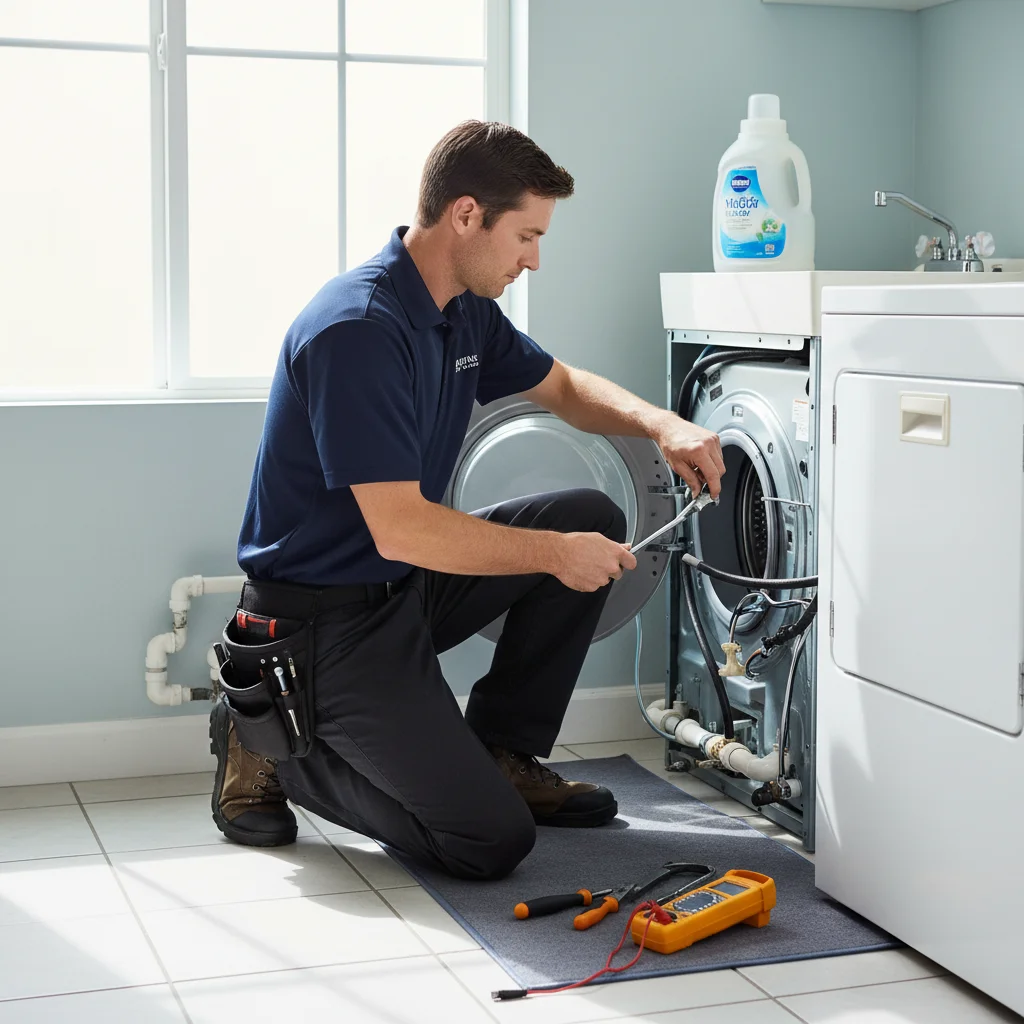
Maytag builds tough machines. Commercial Technology motors, heavy-gauge tubs, long warranties. But San Diego is hard on them. Inland hard water in El Cajon and Santee scales up valves and heating elements. Coastal salt air in Encinitas and Pacific Beach corrodes terminals and lid-lock contacts. East County summer heat pushes dryers and fridge compressors. When a Maytag quits, it usually quit for a reason we’ve seen a hundred times.
Techs in our network open Maytag washers, dryers, fridges, and dishwashers every week across the county. They know which parts fail and why. Here’s our straight take on the Maytag repairs they run into most, and how to tell when a fix is worth it.
The Maytag problems we see most often in San Diego homes
Maytag spreads across washers, dryers, fridges, and dishwashers, but the failure patterns repeat. A lot of modern Maytag breakdowns trace back to the electronics that run the machine, not the heavy mechanical parts.
The main control board fails often across the whole lineup. Maytag calls it the MCU on many washers. A power surge takes one out, and so does years of heat and vibration. The symptoms confuse people. Buttons go dead, error codes contradict each other, or the cycle starts and stops on its own. On Bravos and Centennial top-loaders we see the F1 board error a lot. That code points straight at the control board.
Sensors are the other big category. Maytag washers use a lid-lock switch, a water-level pressure sensor, and a motor speed sensor. On dryers it’s the moisture sensor bars and thermistor. When one of these fails, the whole machine can lock up even though everything else works. The lid-lock switch is the most common. Salt air corrodes the contacts on coastal units, and the machine throws an LD or dL code and refuses to spin.
Motors show up around the five to ten year mark. Maytag Commercial Technology motors are direct-drive and tough, but the rotor position sensor or the wiring harness behind them fails. You get a machine that hums, clicks, and won’t turn. On older belt-drive units a cracked drive belt or seized idler does the same thing. One part swap usually brings the machine back.
Maytag washer and dryer common failure points
Most of our Maytag calls start in the laundry room. Water, heat, and daily loads grind these machines down. We can usually narrow a washer or dryer problem to two or three parts before we even pull up.
Common Maytag washer issues
A few washer problems come up again and again. The shift actuator is the top offender on Bravos and Centennial top-loaders. It switches the basket between agitate and spin. When it fails, the washer fills, sloshes, then leaves you with a soaked load and a UL or LD code. It’s a small part and a fast swap once we confirm it.
The drain pump is next. Techs pull socks, coins, and underwire out of Maytag pump housings constantly. A clogged or burned-out pump throws an F9 E1 code and leaves standing water in the tub. The tech clears the impeller, tests the pump, and replaces it if the motor’s gone.
Worn suspension rods are the quiet killer on top-loaders. The four rods that hang the tub wear out and the machine starts banging and walking across the floor on spin. People assume it’s bearings. On a top-loader it’s almost always the rods, and a tech replaces all four as a set.
On front-loaders, a spin cycle that sounds like a jet engine means failed drum bearings. That’s a real teardown, and on an older machine it’s often not worth it. We also handle a steady stream of lid-lock failures, which is the corroded switch we mentioned, and we see it most on coastal homes in La Jolla and Ocean Beach. A professional washing machine repair for any of these usually wraps up in one visit.
Common Maytag dryer issues
On Maytag dryers, the most frequent complaint is “it’s tumbling, but there’s no heat.” This classic symptom usually points to one of three things: a blown thermal fuse, a bad heating element, or a failed cycling thermostat. The thermal fuse is a safety device that cuts power to the heat source if the dryer overheats, often due to a clogged vent. A technician always checks your venting when replacing one. Another common problem is a loud squealing or thumping noise, which is a tell-tale sign of a worn-out drum belt or idler pulley. These parts are under constant tension and eventually wear out. A prompt dryer repair is important, as a broken belt can lead to more damage if you continue to run the machine.
Repairing Maytag refrigerators and dishwashers
In the kitchen, Maytag refrigerators and dishwashers are workhorses. But when they fail, they can disrupt your entire household. Here’s what we typically see.
Maytag refrigerator repairs
The most common refrigerator call we get is for a unit that’s not cooling properly. Often, the freezer is still cold, but the fresh food section is warm. This usually indicates a problem with airflow between the two compartments, typically caused by a failed evaporator fan motor or a frosted-over evaporator coil due to a malfunctioning defrost system. Another frequent issue involves the ice and water dispensers. We regularly fix failed water inlet valves, clogged water lines, and faulty dispenser control boards. These are often less expensive fixes that can restore full functionality to an otherwise healthy refrigerator.
Maytag dishwasher repairs
For Maytag dishwashers, the number one complaint is that they’re not cleaning dishes effectively. This can be caused by several things, but a common culprit in Maytag models is a clogged or failed chopper assembly. This small part is designed to pulverize food particles before they reach the filter, but it can get jammed. We also see issues with the main circulation pump, which is the heart of the dishwasher. If it fails, water won’t spray onto the dishes with enough force. Finally, control panel issues, where buttons become unresponsive or the display goes blank, often point to a failed electronic control board. These problems are best left to a professional dishwasher repair technician who can safely handle the combination of water and electricity.
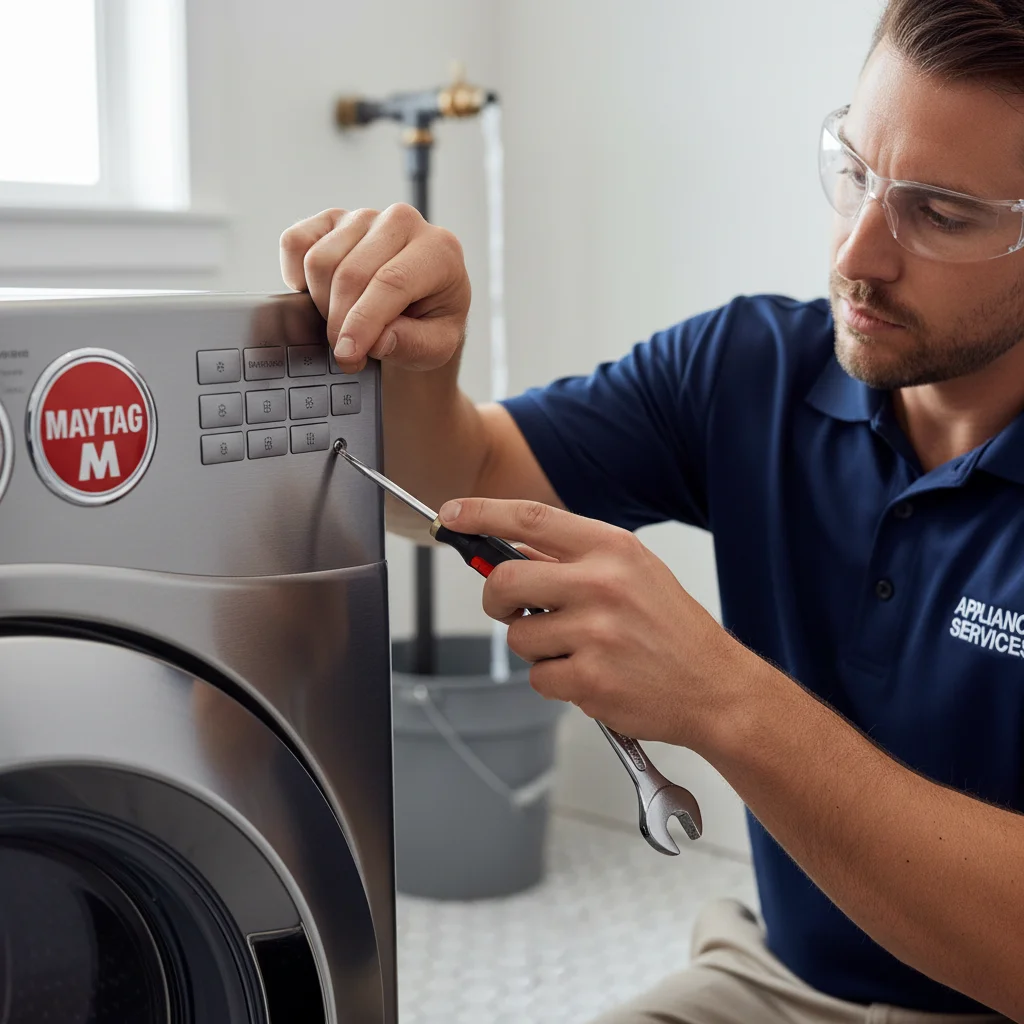
Is your Maytag appliance worth fixing? (the honest math)
This is the most important question, and the answer isn’t always simple. As a rule of thumb, the 50/50 rule works: if the estimated repair cost is more than 50% of the cost of a new, comparable appliance, and your current machine is more than halfway through its expected lifespan (typically 10-13 years for Maytags), then replacement often makes more financial sense.
Let’s break it down:
- Minor repairs on a younger appliance: A drain pump is one of the cheaper parts on a washer, so replacing one on a five-year-old machine is an easy decision. You should absolutely repair it.
- Major repairs on an older appliance: A compressor swap on a 12-year-old refrigerator is a much tougher call. National cost guides such as HomeGuide put a full compressor replacement job at $700 to $1,250 on average. Given the age and the cost, you’re likely better off investing that money into a new, more energy-efficient model with a fresh warranty.
- The in-between: What about a control board replacement on an eight-year-old dishwasher? This is the gray area. The appliance is getting older, but it still has potential life left. In these cases, the matched technician gives an honest assessment of the machine’s overall condition to help you decide.
The matched technician gives you the diagnosis, the part, and the cost before any work starts. Then the call is yours. For a deeper breakdown, read our guide on whether to repair or replace your appliance.
Why choose a local tech for your Maytag repair
A broken Maytag gives you a few options. Call the factory line, take the big-box store’s referral, or hire a local shop like us. The local route usually gets your machine running faster.
Techs in our network stock the parts that fail most: shift actuators, drain pumps, lid-lock switches, dryer thermal fuses, and heating elements ride on the truck. That’s not a guess. It’s the parts list built from years of Maytag calls across San Diego. When the diagnosis matches what’s on hand, the fix happens the same trip instead of ordering and coming back.
We also read the home. A washer in coastal Carlsbad gets checked for corroded contacts. A dryer in El Cajon gets a vent check and a hard-water look at the moisture sensors. Same machine, different wear, depending on where you live. Knowing the county is half the diagnosis.
Frequently asked questions
What does the F1 error code mean on a Maytag Bravos or Centennial washer?
F1 points directly at the main control board, also called the MCU on many Maytag washers. Power surges and years of heat and vibration are the usual causes. The board can be replaced without replacing the entire machine, and it’s one of the more economical fixes on an otherwise sound unit.
Why does a Maytag top-load washer bang and walk during the spin cycle?
Worn suspension rods are almost always the cause, not drum bearings as many owners assume. The four rods that hang the tub wear down over time and let the tub swing hard on spin. Replacing all four as a set fixes the banging and prevents the imbalance from damaging the drum.
What causes a Maytag dryer to tumble but produce no heat?
A blown thermal fuse is the most common cause, followed by a bad heating element or a failed cycling thermostat. The thermal fuse cuts power to the heat source when the dryer overheats, which usually happens because the vent is clogged. A technician replaces the fuse and clears the duct in the same visit so the new part doesn’t blow again.
Does San Diego’s climate affect how Maytag appliances fail?
Coastal homes in places like La Jolla and Ocean Beach see the lid-lock switch corrode from salt air faster than inland machines. Hard water in El Cajon and Santee scales up valves and heating elements. East County summer heat accelerates dryer thermal fuse failures and compressor wear on fridges. The fix often changes with the zip code.
When to call us
If your Maytag is throwing one of these codes, banging on spin, tumbling without heat, or going dead at the panel, let us look at it. Control boards, lid-lock circuits, and water-connected parts mix electricity and water, so they’re not a safe DIY. We track down the failed part, confirm it, and fix it.
Call us at (858) 988-7787 to get matched with a local technician.