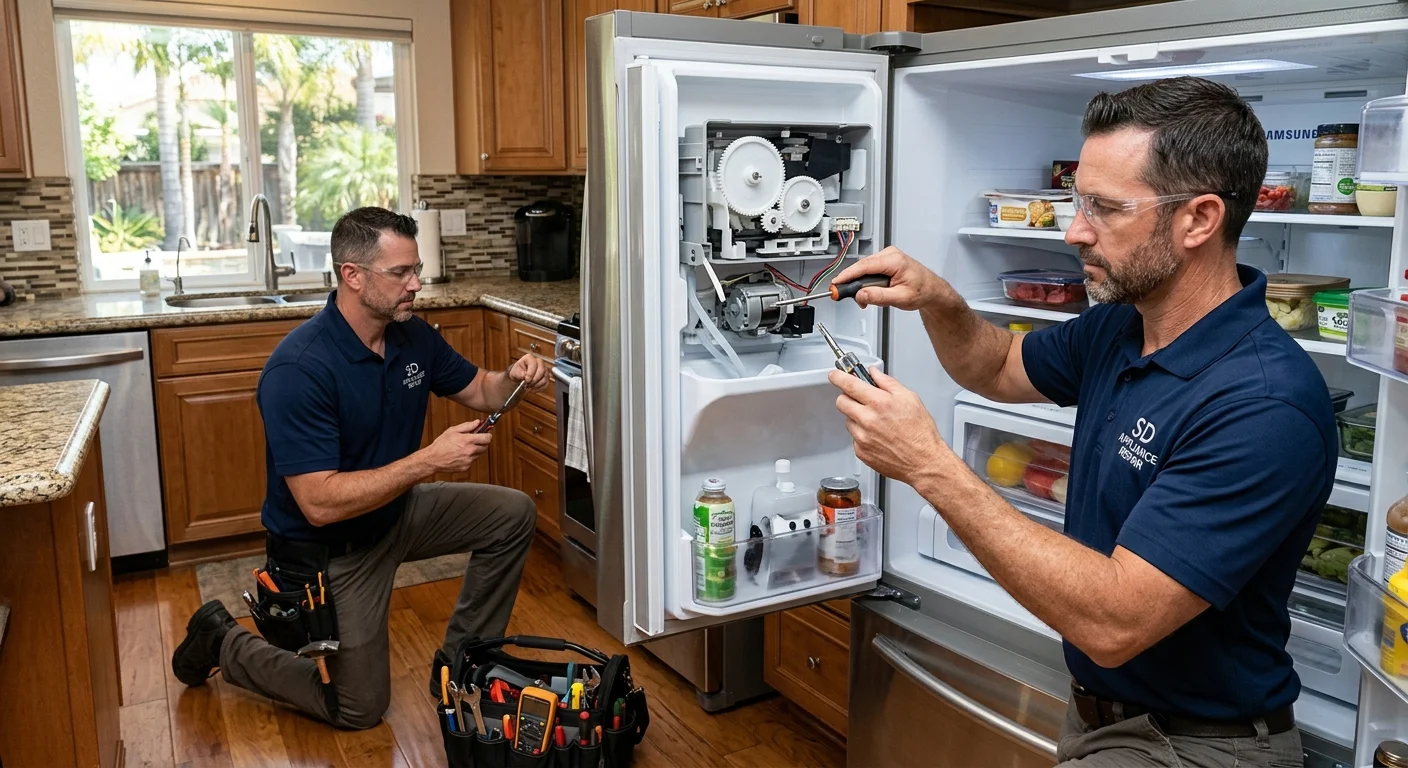
A dead ice maker is one of the most common calls we get. The bin’s empty, or you’re finding water pooled in the bottom of the freezer. Most failures trace back to a handful of parts: the water inlet valve, the ice maker module, the freezer temperature, or the water line. The techs in our network see all of them weekly across San Diego County. Inland homes in places like Santee, El Cajon, and Escondido add another wrinkle. Hard water scales up the valve and the fill tube, and that scaling slowly chokes off ice production.
Why did my ice maker stop working?
An ice maker has a few moving parts, and each one fails in its own way. A technician works through them in order when diagnosing one. Here’s what gets checked and why.
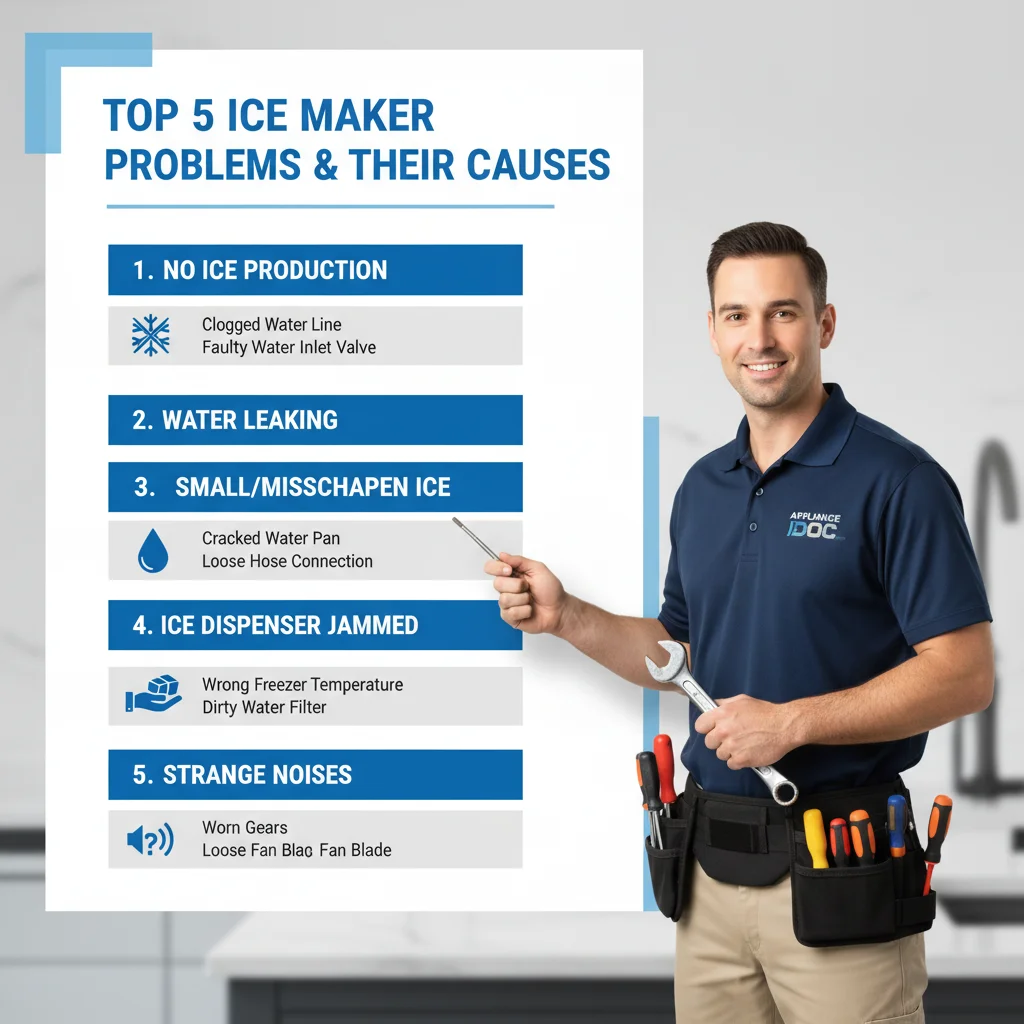
The ice maker not making ice is the call we get most. First, the technician checks freezer temperature. The ice maker won’t cycle if the freezer sits above about 10 degrees, so a warm freezer is often the real culprit. Next is the water inlet valve. It’s the part that opens to fill the mold, and it fails open, fails closed, or scales shut from hard water. A weak fill or a slow trickle instead of full cubes usually means the valve or low house water pressure. The technician also checks the fill tube for an ice plug, and the ice maker module itself, the small motor and gear assembly that ejects cubes and cycles the unit. For more specific troubleshooting, check out our guide on /blog/ice-maker-not-making-ice/.
Water leaking around the ice maker almost always comes from one of three spots. A water inlet valve that won’t fully close keeps dripping into the mold and overfills it. A cracked or split fill tube leaks behind the unit. Or the saddle valve on the supply line under the sink is weeping. The technician traces the water back to the source instead of guessing. Catching it early keeps it off your floors and out of the cabinet.
Ice dispensing problems on through-the-door models usually point to the dispenser auger motor or the optics boards. Those are the emitter and receiver sensors that tell the unit the bin is full. When they fog up or fail, the maker stops or overfills. Cubes that freeze into one solid clump mean the bin’s been sitting too long, or warm air is leaking past the door gasket and refreezing. Grinding or clicking noises are mechanical. We usually find stripped gears in the module or an auger jammed by a stuck cube. None of these get better on their own, and a wrong part swap gets expensive fast.
All types of ice makers: countertop, built-in, and freezer units
Most of our calls are the ice maker built into a refrigerator freezer, top-mount, side-by-side, or French-door. The parts are similar across them, but the failure points differ. Top-mount units are simple and usually it’s the module or the valve. Side-by-side and French-door models add the dispenser, the auger, and the optics, so there’s more to go through.
The network also handles standalone built-in ice makers, the under-counter units in kitchens and bars. These run their own sealed cooling system instead of borrowing cold from the freezer. So on top of the valve and the harvest motor, the technician checks the condenser, the compressor, and the control board. The condenser coils on these clog with dust and pet hair, which kills ice output and overheats the compressor. A quick coil cleaning brings a lot of them back.
The network can also help with portable or countertop ice makers, though on the cheaper ones a repair often costs more than the unit. A good technician will tell you straight if it’s worth fixing. No matter the type, a technician can get your ice supply back. Visit our dedicated /services/ice-maker-repair/ page for more details.
Samsung, Whirlpool, LG ice maker repair specialists
Some brands fail in predictable ways, and Samsung French-door fridges are the worst offender we see. The ice maker compartment frosts over and freezes the whole assembly in a block of ice. The root cause is usually a poor seal around the ice maker housing letting humid air in, plus a defrost cycle that can’t keep up. The techs in our network have thawed and resealed a lot of these in homes from Chula Vista to Carmel Valley. The network handles Samsung refrigerator ice maker repair all the time, and technicians typically carry the gaskets, the auger motors, and the ice maker assemblies these units burn through. Learn more about specific Samsung issues on our /blog/samsung-refrigerator-ice-maker-repair/ post.
Whirlpool and LG show up in a lot of San Diego kitchens too. On Whirlpool, the most common fix is the optic-board flap motor or a water inlet valve that’s scaled shut from hard water. LG’s linear-compressor models are prone to frozen fill tubes and the occasional bad ice maker assembly. Technicians in the network typically keep the common valves, optics boards, and modules for both on their trucks, so a lot of these get fixed on the first visit instead of waiting on a part order.
Hard water is the thread running through most brand failures inland. The minerals in East County and North County water build up on the inlet valve and inside the fill tube until ice slows to a crawl. When a scaled valve gets replaced, a good technician will tell you straight that a fridge filter or a softener will make the new part last. That’s the difference between a real fix and a repeat call.
How an ice maker repair and diagnosis visit works
Here’s how a service call actually runs, start to finish. A good technician doesn’t skip steps, because a misdiagnosed ice maker means a wasted part and a second trip.
- Scheduling: Tell us the brand and what it’s doing, frozen up, leaking, or just empty. That helps the technician bring the right parts to your San Diego County appointment.
- Arrival with the right parts: The technician shows up with the common valves, modules, optics boards, and gaskets already on hand. That’s how a lot of these get done in one visit.
- Diagnosis in order: The technician checks freezer temperature first, then the water inlet valve, the fill tube, the module, and on dispenser models the optics and auger motor, testing the valve for resistance and watching a full harvest cycle instead of guessing.
- The estimate: Once the failed part is identified, the technician explains what it is and what the repair takes. You get the price before any work starts. No surprises.
- The repair: With your okay, the technician replaces the part and checks the water pressure and supply line while there. On a scaled-up inland unit, the technician flags whether a softener or filter will protect the new part.
- Testing: The technician runs a full cycle and confirms cubes drop and dispense before leaving. A Samsung that froze up gets a humidity-seal check so it doesn’t ice over again next week.
Get your ice maker fixed
Whether it’s a Samsung frozen into a block, a leaking inlet valve, or a unit that quit after years of hard water, a technician can fix it. The network covers every refrigerator brand and every ice maker type across San Diego County, from the coast to East County. The techs in our network diagnose the actual failed part, typically carry the common ones on their trucks, and tell you straight when a repair is worth it. That’s the whole job: find the real cause, fix it once, and keep it from coming back.
Frequently asked questions
Why does hard water cause ice maker problems in San Diego?
Inland areas like Santee, El Cajon, and Escondido have high mineral content in the water. Those minerals build up on the inlet valve and inside the fill tube, slowly choking off flow until cubes shrink or stop entirely. Replacing the scaled valve and adding a water filter protects the new part.
Why do Samsung French-door ice makers freeze up?
Poor sealing around the ice maker housing lets humid air in, and the defrost cycle can’t keep up with the frost load. The entire assembly freezes solid, blocking the auger and sensors. A proper repair includes thawing the unit and resealing the housing so it doesn’t refreeze.
What’s the difference between a freezer ice maker and a built-in under-counter ice maker?
Freezer ice makers borrow cold from the refrigerator’s sealed system. Under-counter models run their own compressor, condenser, and harvest motor. Diagnosing a built-in means checking the sealed system and control board in addition to the valve and harvest motor.
How do I know when to repair versus replace an ice maker?
The technicians in our network give a straight answer after diagnosing the actual failed part. A valve or module swap on a recent fridge is almost always worth it. On a cheaper countertop unit, repair often costs more than a replacement, and we’ll tell you that upfront.
When to call us
Call us when the bin’s been empty for a day, when you see water pooling, when a Samsung freezes over, or when cubes come out small and slushy. Ice maker work mixes a live water line with electrical parts, so a bad valve swap can flood a cabinet or trip a breaker. The techs in our network handle the water and the wiring safely and get it right the first time. Call us at (858) 988-7787 to get matched with a technician.