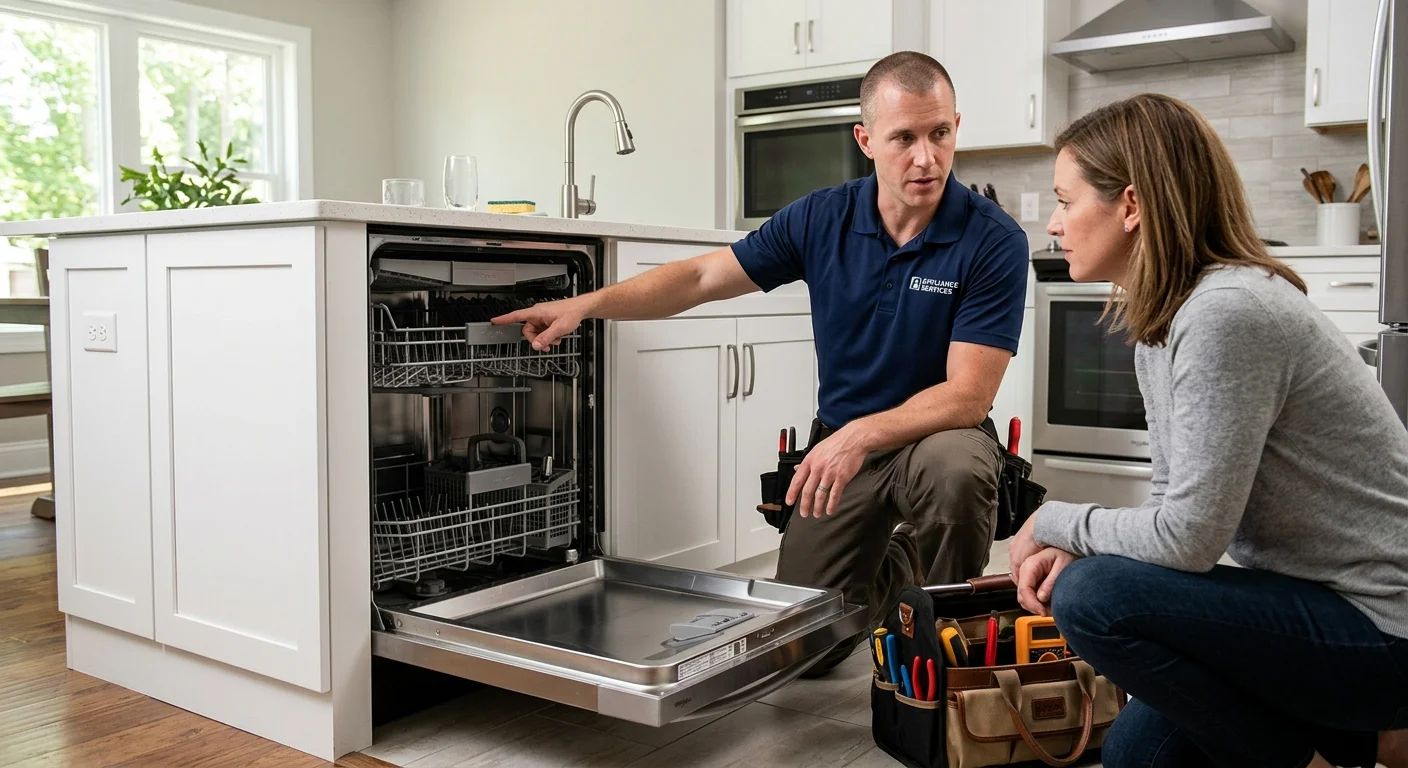
A dishwasher that quits mid-cycle stacks up dishes fast. Record the pattern: plates come out gritty, water pools under the unit, or the panel goes dark. Those notes help a matched technician start diagnosis. They do not name the failed part by themselves. The technician diagnoses the fault, then quotes the fix in writing before any work starts.
Common dishwasher problems in San Diego homes
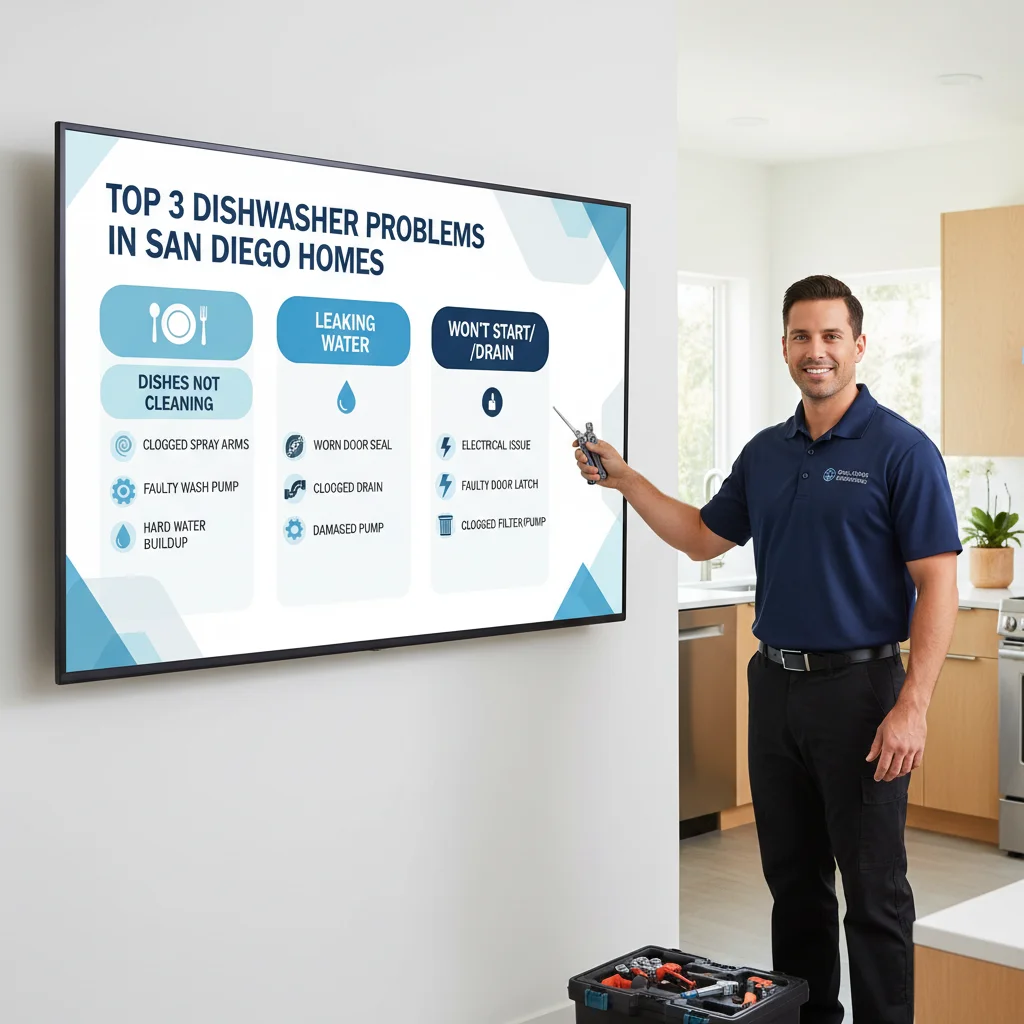
Water quality varies across San Diego County. Inland cities such as El Cajon, Santee, Poway, and Escondido often have harder tap water than coastal neighborhoods. Mineral scale on a heating element or spray-arm holes can show up in a diagnosis. It is one observation for the technician, not a proven local cause of every dirty-dish call. Coastal homes in La Jolla, Carlsbad, and Encinitas can still have chopper or pump debris. Tell the technician what you hear and where water sits.
A grinding noise on the drain cycle can be debris in the impeller. A humming dishwasher that will not drain can be a pump that will not turn. The technician confirms which it is before quoting a clear or a part swap.
Leak location is useful, not a parts map. Water at the front of the door is worth checking against the door gasket. Water pooling under the center or back can involve the pump, sump, or drain hose. A dishwasher leaking from the bottom still needs a diagnosed source. When your dishwasher isn’t cleaning, start with the filter if the model manual allows it, then leave spray arms, wash motor, and heating tests to the technician.
Brands technicians in the network may see: Bosch, KitchenAid, Maytag, and more
Brand and model change how a code should be read. Bosch displays such as E15 and E24 are examples, not universal meanings. Confirm them in the owner’s manual for that exact Bosch model before treating them as a base-pan flood or a slow drain. KitchenAid, Whirlpool, Maytag, Samsung, LG, GE, and Kenmore faults still need the same model document, not a shared failure list. Our Bosch dishwasher error codes page is a starting index. It is not a substitute for the chart printed for your serial.
Repair Pro San Diego matches you with independent technicians. We do not stock dishwasher parts or promise a one-visit repair. Ask the matched provider what they carry and get the diagnosis in writing.
What a San Diego dishwasher repair visit may include
Independent technicians set their own process. Repair Pro San Diego does not run a shared diagnostic script. Ask the matched provider what they will inspect. Typical checks can include a test cycle, the pump sound, fill and drain, the filter, spray arms, and meter tests on parts that belong in that diagnosis. Then you should get a written quote before any work starts.
What gets replaced depends on the diagnosis. A pump, inlet valve, latch switch, control board, spray arm, heating element, filter, or gasket can be involved. None of those is automatic from a symptom. Parts on a truck belong to that independent provider. Do not count on a one-trip finish.
Understanding dishwasher repair costs
Repair cost tracks with which part failed. Clearing a clogged filter or reseating a drain hose is the cheap end. A new control board or a wash motor sits at the top, since those parts cost more and take longer to install. The brand matters too. Bosch and high-end European boards run higher than a Whirlpool or Kenmore pump. Labor reflects how deep the part is buried. A drain pump you reach from the front is quicker than a sump or motor that means pulling the unit. Ask whether the quoted part is specified for that model. There is no approved dishwasher lifespan cutoff and no 50% replacement rule on this site. Compare the written repair quote with a real replacement for that opening.
The technician quotes in writing before work starts. If scale is present, that is part of the diagnosis, not a scheduled six-month hard-water service we control.
Leaking, not cleaning, or won’t start
A leaking, dead, or dirty-dishes dishwasher needs a diagnosis. A slow leak can damage the cabinet floor. A drain clog left alone can overwork the pump. Technicians in our network cover the whole county, from coastal Carlsbad and Del Mar to inland Chula Vista, El Cajon, and Escondido. Ask whether they will run a test cycle before calling the job done. That step is their process, not a brand guarantee.
If water is actively pooling or the dishwasher tripped a breaker, treat it as urgent for your kitchen and use our emergency appliance repair referral path. We do not flag guaranteed priority intake. If the model manual allows it, shut the unit’s water valve under the sink and kill the breaker until the technician arrives. The technician traces the leak and quotes the source in writing.
Frequently asked questions
What are the most common dishwasher problems in San Diego?
Gritty dishes, standing water, and a dark control panel are patterns owners often describe. They are useful notes, not a ranked inbound list for this site. Gritty dishes can involve the filter or spray arms. Standing water can involve the drain path. A dead panel can involve the latch or control. Inland hardness is context for the technician, not a confirmed cause.
Why do dishwashers fail faster in San Diego’s inland areas?
Inland tap water can be harder than coastal tap water. That can leave mineral film on heat and spray parts, but it is not a measured failure rate for this site. Coastal homes can still have pump and chopper debris. Ask the technician what they actually find.
Does a Bosch E15 or E24 error code mean I need a new dishwasher?
Not by default. Confirm E15 and E24 in the Bosch manual for that exact model. Shared blog lists are not the chart for your serial. Many drain and flood codes are repairable once the technician confirms the fault.
Is a leaking dishwasher worth repairing or should I replace it?
Compare the written repair quote with a real replacement. Leak location is a clue, not a price. A cracked tub can make replacement the clearer option after diagnosis. There is no approved 50% rule.
When to call us
Some fixes are fine to try yourself. Cleaning the filter, clearing the spray arm holes, and checking the drain hose are all homeowner jobs. Call us when the failure is electrical or mechanical. A control board that won’t power on, a pump that hums but won’t drain, a heating element that won’t heat, or a leak you can’t trace all need a meter and the right part. Pulling a control board or wiring a new pump wrong can short the unit or void the warranty. The technician handles those with the correct parts and testing. Call us at (858) 988-7787 to get matched with a technician.