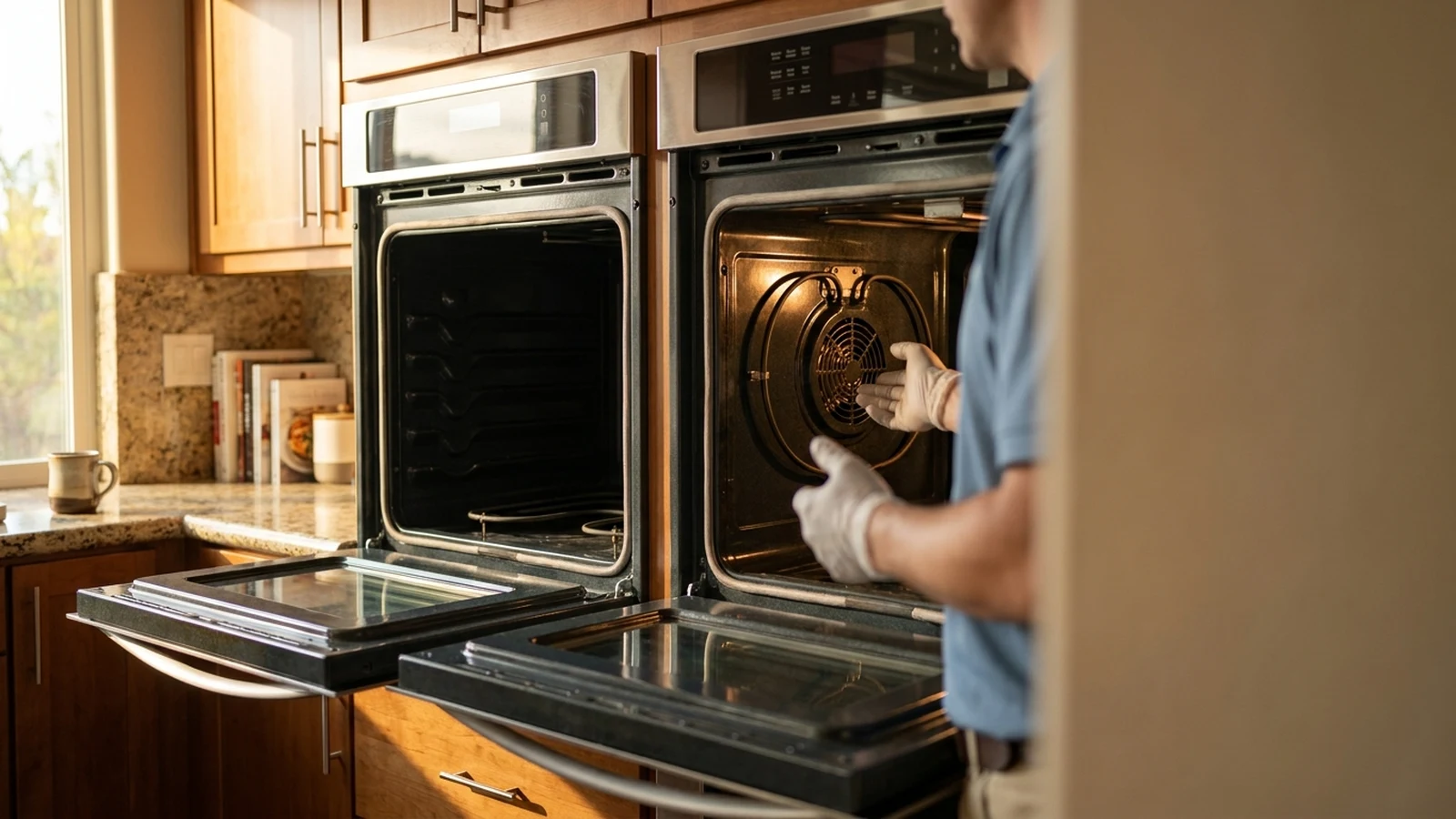
A convection oven uses a fan, and some true-convection models add a third element around the fan. Moving air can cook faster and more evenly than still heat. A conventional oven relies on radiant heat from top and bottom elements. How much faster, and whether you should lower temperature or time, belongs in the recipe and the oven’s use-and-care guide, not a universal 25-30% rule applied to every model. Most new ovens include a convection mode and a way to bake with the fan off. Compare those modes on the exact specification sheet.
The short version
Convection circulates air with a fan, and on some models a ring element. It can brown more evenly on multiple racks. Extra moving part: the fan motor.
Conventional heats from fixed top and bottom elements with still air. Simpler cavity. Some delicate bakes are still recommended in still-air mode by the manufacturer.
If you roast or cook on more than one rack, convection may fit. If you bake delicate items, check whether the model has a conventional or true-bake mode. Use the manual, not a ranking of which type fails more.
Side-by-side comparison
| Convection | Conventional | |
|---|---|---|
| How it heats | Fan plus top and bottom elements; some true-convection models add a ring element around the fan | Top and bottom elements only, still air |
| Cook time | Often shorter at the same setpoint; confirm in the manual | Baseline for still-air recipes |
| Even browning | Often better on multiple racks when the fan is working | Can be uneven without rotating, depending on the oven |
| Best for | Roasting, sheet-pan meals, multi-rack baking (if the maker says so) | Delicate bakes when the maker recommends still air |
| Extra moving part | Fan motor and blade on convection models | None for a fan |
| Possible repairs | Fan motor, fan blade, extra element if equipped | Bake or broil element, temperature sensor |
| Repair cost | Ask for a written diagnosis; don’t rank types | Same |
| Recipe conversion | Follow the oven and recipe instructions | Use recipe as written unless the oven says otherwise |
How convection actually cooks differently
A conventional oven heats the way ovens have worked for a century: a bottom element for baking, a top element for broiling, and still air in between. Heat rises and pools near the top, which is why the top rack runs hotter than the bottom and why a lot of home bakers rotate pans halfway through.
A convection oven adds a fan, usually on the back wall, and on some models a third heating element around that fan. The fan moves air so the cavity can stay more even. Some manufacturers suggest a lower temperature or a shorter time than a conventional recipe. Use that model’s published conversion, not a blanket 25°F or 25% rule.
The tradeoff shows up on delicate bakes. Moving air dries the surface of a soufflé or custard before the inside sets, and it can blow a light batter around before it firms up. That’s why most convection ovens include a true-bake or “conventional” mode that shuts the fan off, and most manufacturers still recommend it for anything egg-based or delicate.
What actually breaks on each
The fan and any extra element are additional parts. They can wear. They are not a reason to call convection ovens less reliable overall.
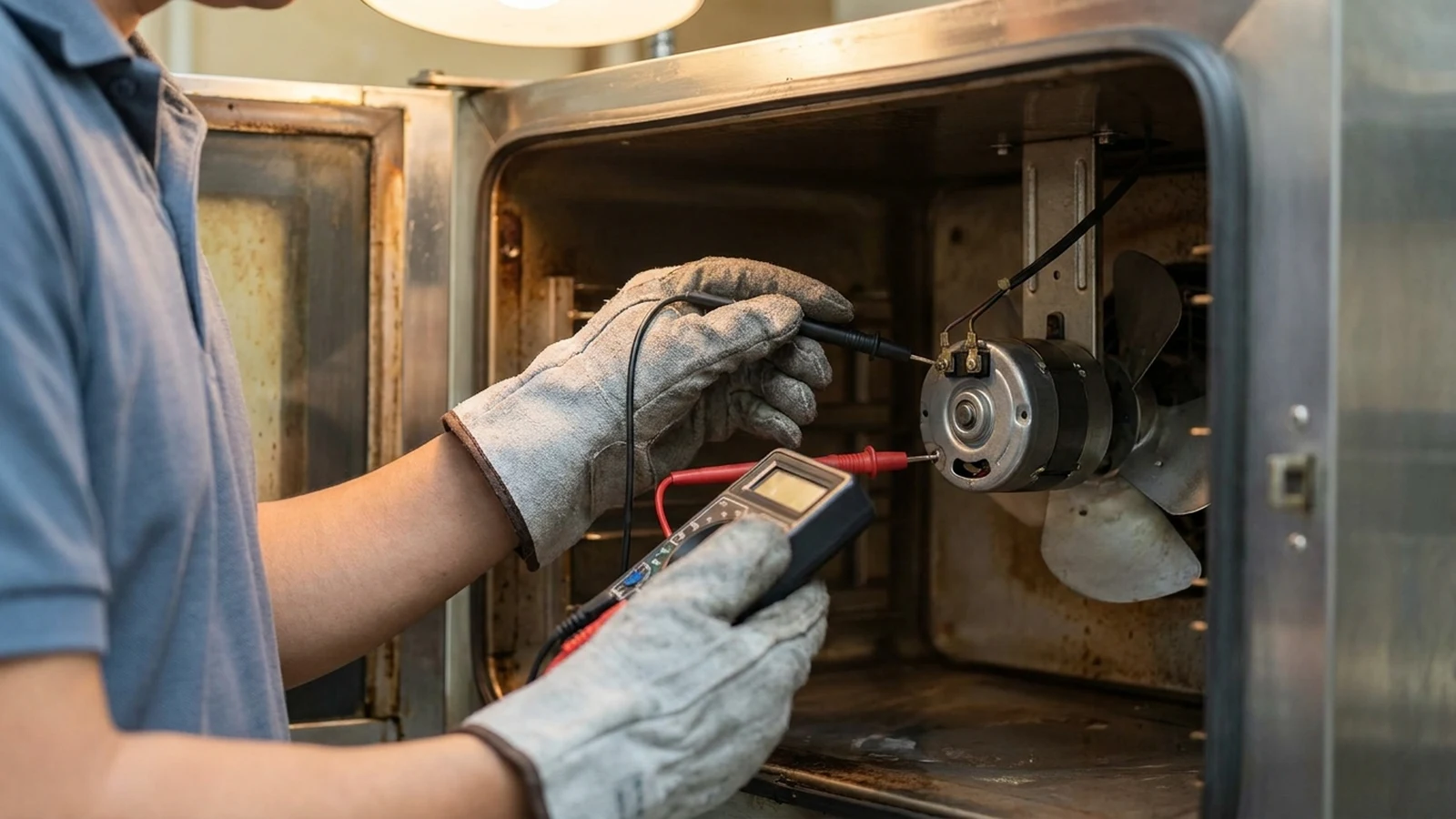
Convection fan motor and blade
The fan motor sits behind the rear panel on many designs and runs in convection mode. Noise or a seized fan needs inspection. A full fan motor swap is quoted after diagnosis. See oven repair costs for how quotes work, not a midrange ranking.
Bake, broil, and convection ring elements
Both oven types can burn out a bake or broil element. Some true-convection models add a ring element. Element replacement is quoted for the exact part. Don’t assume the ring always costs more.
Neither issue is a reason to avoid convection. See oven repair in San Diego for how matched technicians diagnose no-heat and uneven-heat calls.
Buying: which one should you get?
Most new ovens now include a convection mode, from budget ranges to high-end wall ovens, so the real decision is rarely convection-only versus conventional-only. It’s whether you want a model that also gives you a true conventional mode to fall back on, which almost all do.
- Get convection (with a conventional fallback) if: you roast meat and vegetables often, cook sheet-pan dinners, bake on more than one rack, or want faster weeknight cook times.
- Lean on conventional mode if: you bake a lot of custards, cheesecakes, soufflés, or delicate pastries where moving air causes uneven rise or a dry surface.
- Budget consideration: Compare purchase price and the written service quote for your model. Don’t assume convection always has a higher repair ceiling.
If you already own a convection oven and mostly use conventional mode out of habit, there’s no reason to avoid the fan. Convection roasts a chicken or a sheet of vegetables noticeably better, and switching modes takes one button press.
When to call us
If your convection fan has started making noise, stopped spinning, or your oven is cooking unevenly with the fan running, request a diagnosis. Whether that fault is worth repairing versus replacing belongs on the technician’s written quote, not this page. Our oven and range repair referral covers gas and electric, convection and conventional. Ask whether the matched technician services your brand and model. Repair Pro San Diego does not guarantee every major brand. The technicians we match diagnose first and give you a written part-and-labor quote before any work starts. Ask the technician about their diagnostic fee and whether it’s credited toward the repair. We also serve appliance repair in Encinitas and throughout San Diego County.
Call (858) 988-7787 to leave a voicemail requesting a diagnostic match.
Frequently asked questions
Is a convection oven worth the extra money?
Compare how you cook with the model’s published modes. Faster, more even cooking is a reason many people use convection. It is not a universal payoff. If you mostly bake delicate items, see whether the oven includes a still-air mode.
Do I need to adjust recipes for a convection oven?
Follow the oven’s use-and-care guide and the recipe. Some makers suggest a lower temperature or shorter time. Don’t apply a blanket 25°F or 25% conversion to every oven.
What causes a convection fan to stop working?
Possible causes include a worn motor bearing or a damaged blade. Both need inspection with the oven open. Repair versus replacement of the oven is a written quote, not a default.
Is it more expensive to repair a convection oven?
It can be, if the failed part is the fan or ring element a conventional oven doesn’t have. It can also be the same bake-element job either way. Ask for the diagnosis in writing.
Can I still use conventional mode if my oven has convection?
If the model includes a true-bake or conventional setting, that mode turns the fan off. Confirm it in the spec sheet. Use still air when the manufacturer recommends it for a dish.